

There are nearly 200,000 more names on Toronto's voters' list than there were when Olivia Chow won the 2023 mayoral by-election. If you are running a campaign based on who you spoke to last time, that is quite a few people to catch up with.
Toronto Elections provided us with the ward counts as of August 28, 2026. Compared with the final 2023 list, the number of electors is up from 1,947,242 to 2,141,684. That is an increase of 194,442, or 10.0%.
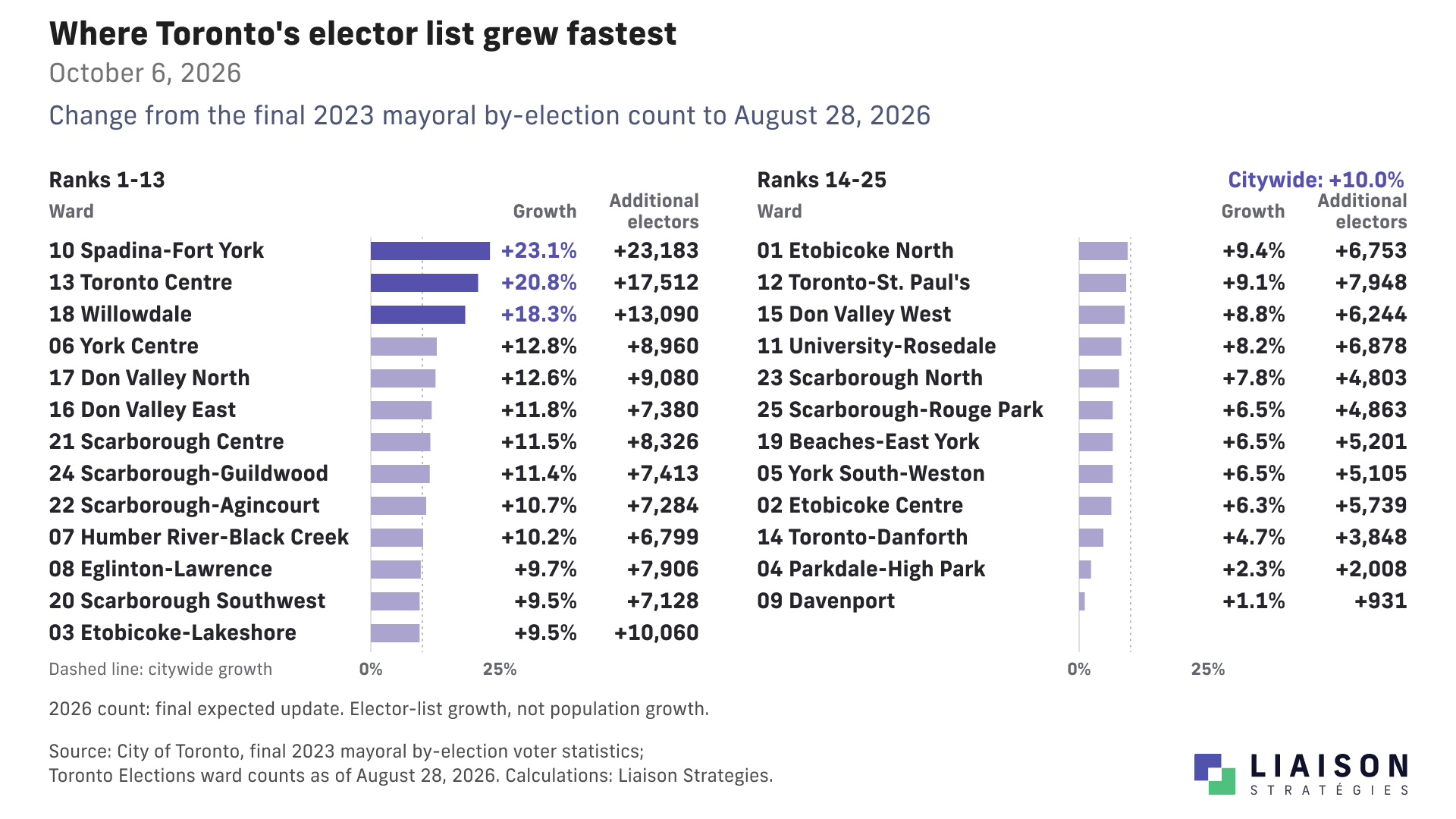
Every ward has more electors. But the changes in Spadina-Fort York, Toronto Centre and Willowdale are particularly interesting, and they deserve some attention from anyone trying to work out where this election will be won.
These are voters' list figures, so we should not confuse them with population growth. People move, become eligible and get added to the list; records also get corrected. We cannot identify how much of the increase comes from each of those things. What we can see is where the list has changed most.
Spadina-Fort York is up almost a quarter
Spadina-Fort York added 23,183 electors, an increase of 23.1%. Its count went from 100,319 to 123,502 in a little over three years.
Toronto Centre added 17,512, up 20.8%. Together, those two downtown wards account for 20.9% of the city's net increase. That is one-fifth of the increase in just two wards.
Willowdale is third, adding 13,090 electors, or 18.3%. Between these three wards, we are talking about 53,785 additional electors: 27.7% of Toronto's increase.
I would want to know how well my campaign's voter contacts match the current list in those wards. How many people have we actually spoken to? How many know who our candidate is? How many have an opinion, and how many are still barely following the race?
That matters for the mayor as well as the challengers. Being well known across Toronto is an advantage, but it does not tell you how familiar any particular voter is with your record. And for a challenger, introducing yourself is still a fairly important part of getting someone to vote for you.
There is plenty of growth elsewhere too. Etobicoke-Lakeshore added 10,060 electors, the fourth-largest increase by number. Don Valley North added 9,080. York Centre's count is up 12.8%.
Compare that with Davenport, up 1.1%, Parkdale-High Park, up 2.3%, and Toronto-Danforth, up 4.7%. All three have more electors, but a campaign in Spadina-Fort York has a much bigger change to account for.
North York grows fastest, Downtown adds the most
At the regional level, North York had the fastest growth, at 11.3%, adding 64,564 electors. Downtown added slightly more people to the list, 67,509, an increase of 9.8%. Together, they account for 67.9% of the citywide increase.
Scarborough added 39,817 electors, up 9.6%, and Etobicoke added 22,552, up 8.4%.
But something interesting happens when we look at each region's share of the whole city: very little changes.
Downtown was 35.29% of Toronto's electorate in 2023 and is now 35.24%. North York moves from 29.47% to 29.81%. Scarborough goes from 21.39% to 21.31%, and Etobicoke from 13.85% to 13.64%.

North York is the only region to gain share, and even there the change is 0.34 percentage points. That is worth noting, but I would not rewrite an election strategy around it.
The individual ward changes are much more substantial. If you are looking for something useful for a campaign, I would spend more time on Willowdale's 18.3% increase than on North York's small gain in citywide share.
And before anyone starts assigning those additional electors to a candidate, we do not know how they intend to vote. Living in a ward where a candidate did well in 2023 does not mean you supported that candidate, particularly if you were not on the list there at the time.
More electors means a higher spending calculation
The list also matters for campaign finances. Toronto's general spending-limit formula for mayor is $7,500 plus 85 cents per eligible elector. For councillor candidates, it is $5,000 plus 85 cents per eligible elector in the ward. The calculation uses electors, not the city's total population.
Using the two counts in this analysis, the mayoral formula produces $1,662,655.70 for the 2023 list and $1,827,931.40 for the August 2026 list. The difference is $165,275.70.
The same calculation is useful at the ward level. Spadina-Fort York's additional electors translate into approximately $19,706 more under the councillor formula. Toronto Centre's translate into $14,885, and Willowdale's into $11,127.
For a campaign able to raise the money, that could mean more advertising, more literature or more paid organizing. But a higher limit does nothing for a candidate who was already struggling to fund the campaign. They still have to raise it.
Who will actually vote?
The part we do not have yet is turnout. A larger list gives campaigns more potential voters to reach. How many of them participate will determine how much these changes matter on election night.
Campaigns are already busy enough without adding another 194,442 names to the job. But relying on who you knew in 2023 is a particularly poor plan in a ward where the elector count has grown by more than 20%.
For me, Spadina-Fort York, Toronto Centre and Willowdale are the places to watch in this comparison. The list has changed considerably, and I would want to see whether the campaigns have kept up.
About the data
The 2023 figures are the City of Toronto's final eligible-elector counts for the mayoral by-election. The 2026 ward counts were provided directly by Toronto Elections, City of Toronto. Changes measure electors on the list, not population growth or ballots cast.
About Liaison Strategies
Liaison is a member of the Canadian Research Insights Council (CRIC), Canada’s voice of the research, analytics, and insights profession both domestically and globally.
