

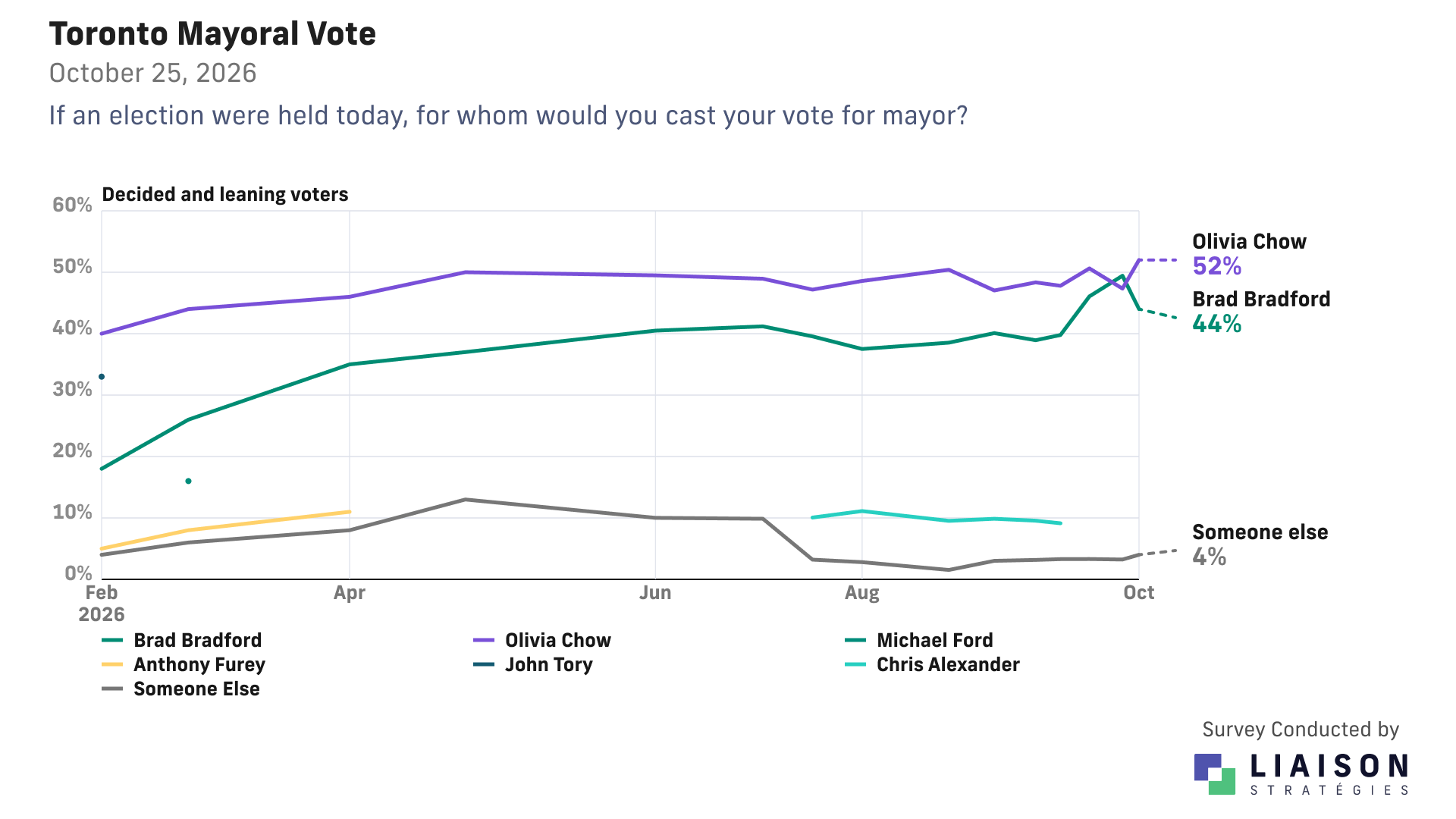
October 25, 2026 (Toronto, ON) - The latest Liaison Strategies Toronto Pulse results put Olivia Chow at 52% among decided and leaning voters, followed by Brad Bradford at 44% and someone else at 4%. With the candidates drawing support from different parts of Toronto, the geographic composition of the final vote will be important.
Liaison surveyed a random sample of 750 Toronto residents from October 24 to October 25, 2026, using Interactive Voice Recording (IVR) technology. Participants were reached through random digit dialling (RDD) across both landline and cellular phone networks. The resulting data was weighted to match targets based on the 2021 Census. For the total sample, the margin of error is +/- 3.6 percentage points, 19 times out of 20. The margin is higher for subsamples, including decided and leaning voters. Results may not add to 100% due to rounding.
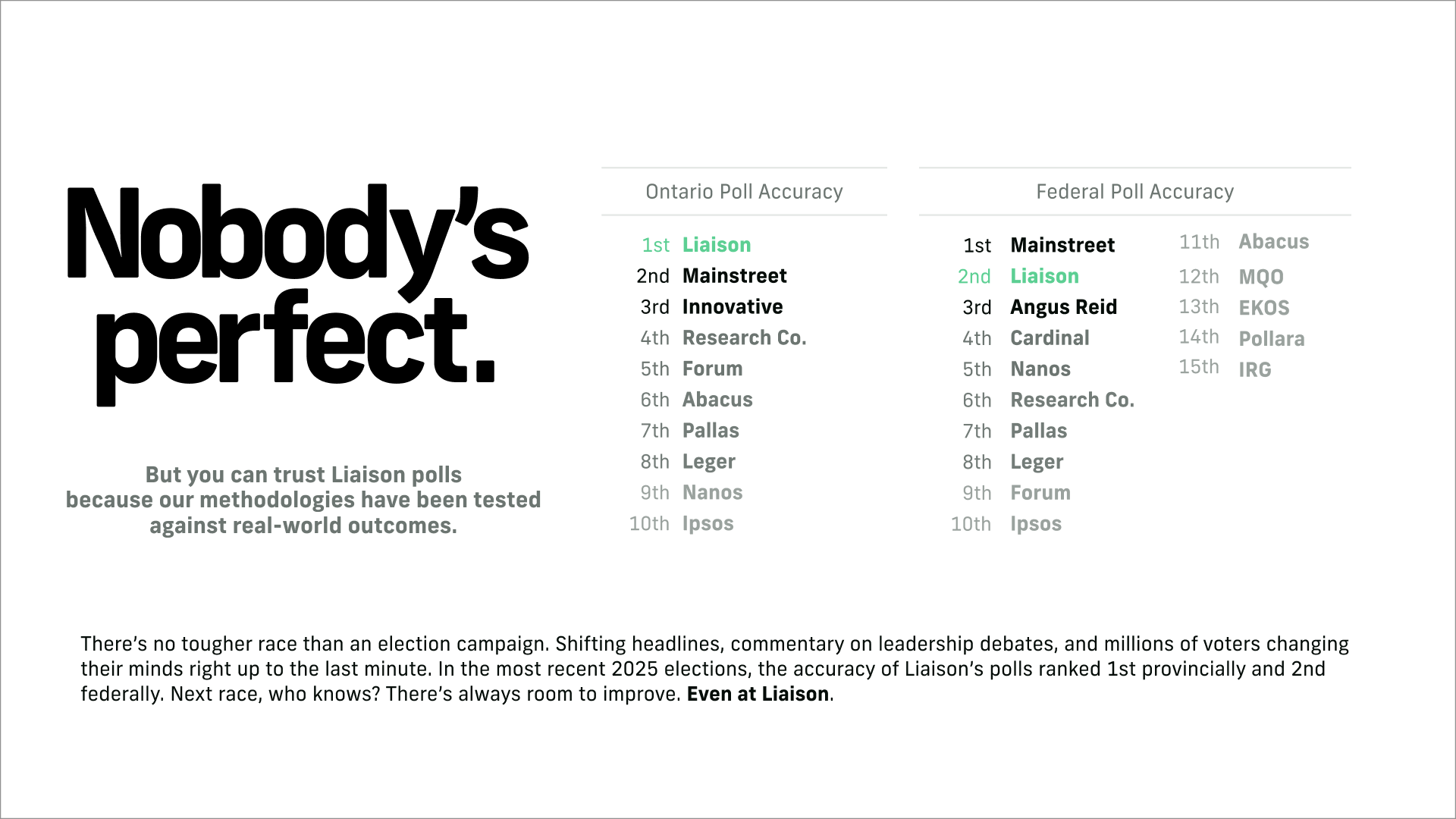
Liaison Strategies is one of the most accurate polling firms in Canada. It ranked #1 in accuracy in the 2025 Ontario election and #2 nationally in the 2025 federal election. Liaison is a member of the Canadian Research Insights Council.
David Valentin, Principal at Liaison Strategies, said:
"Chow leads Bradford by eight points, reversing the two-point Bradford advantage in our previous survey. Among all respondents, 6% are undecided, down from 14%."
"But support is only part of the calculation. Where voters turn out will help determine how those regional preferences translate into a citywide result."
"Chow leads Downtown by 60% to 35% and in Scarborough by 51% to 44%. Bradford leads in Etobicoke by 54% to 41% and in North York by 52% to 46%. Those differences mean the share of Toronto's votes coming from each region can affect the citywide result, even if preferences within those regions stay the same."
"Downtown accounted for 39.7% of all votes cast in the 2023 mayoral by-election, compared with 38.0% in 2022 and 37.2% in 2018. It has supplied a growing share of the votes that decide the mayor."
"Downtown was at about 40% of this year's advance vote. But election-day voters can change that mix. A strong advance turnout in one region does not guarantee it will supply the same share of the final vote."
"A larger Downtown share would help Chow, given her lead there. A larger share from Etobicoke or North York would help Bradford. Scarborough matters too: Chow leads there, but by considerably less than she does Downtown."
"Among women, Chow leads by 55% to 41%. Among men, the candidates are tied at 48%. Chow also leads among voters under 50 and those aged 65 and older, while Bradford has a narrower advantage among voters aged 50 to 64."
"Chow's approval stands at 51%, with 43% disapproving. Yet the city is evenly divided on its direction, with 47% saying right direction and 47% saying wrong direction."
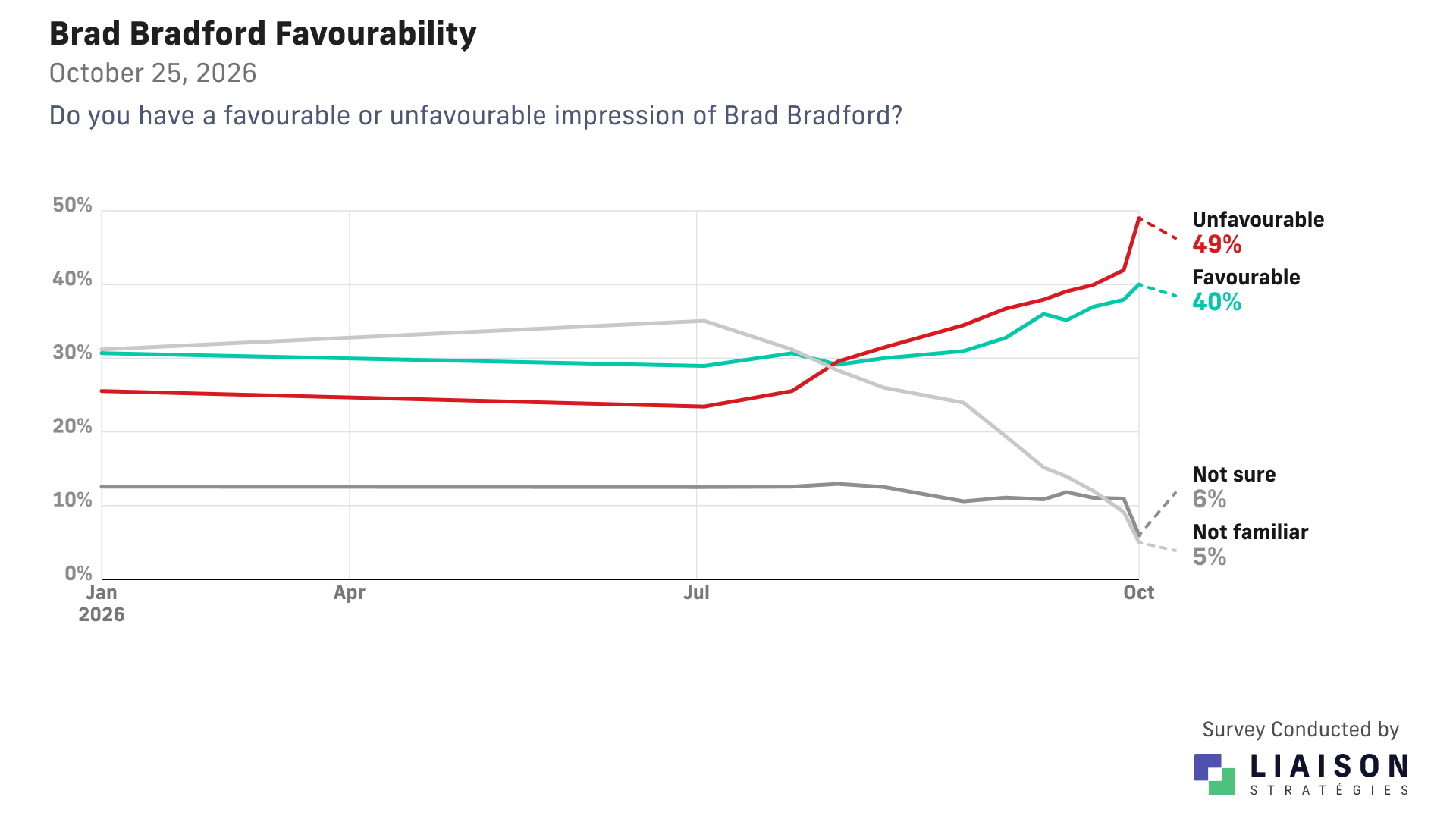
"Bradford's challenge is that more voters view him unfavourably than favourably, by 49% to 40%. His vote is stronger than his personal rating. That leaves him competing for voters who may want a change at City Hall without being especially enthusiastic about the alternative."
"Chow enters election day ahead in these results. A larger Downtown share of the final vote would favour her. Stronger participation in North York and Etobicoke, relative to Downtown, would favour Bradford. The remaining undecided voters could also affect the margin."
-30-
Detailed Poll Report:
Detailed Tables:
About Liaison Strategies
Liaison Strategies is a national public opinion research firm. With 13 years of experience in Canadian polling, David Valentin, principal, has fielded hundreds of projects at the municipal, provincial and federal levels and appeared across Canadian media to discuss insights. Liaison is a member of the Canadian Research Insights Council (CRIC), Canada's voice of the research, analytics, and insights profession both domestically and globally.
About Liaison Strategies
Liaison is a member of the Canadian Research Insights Council (CRIC), Canada’s voice of the research, analytics, and insights profession both domestically and globally.
