

(Toronto, ON) – The latest Ontario Political Tracker from Liaison Strategies shows the Progressive Conservatives and Ontario Liberals tied among decided and leaning voters.
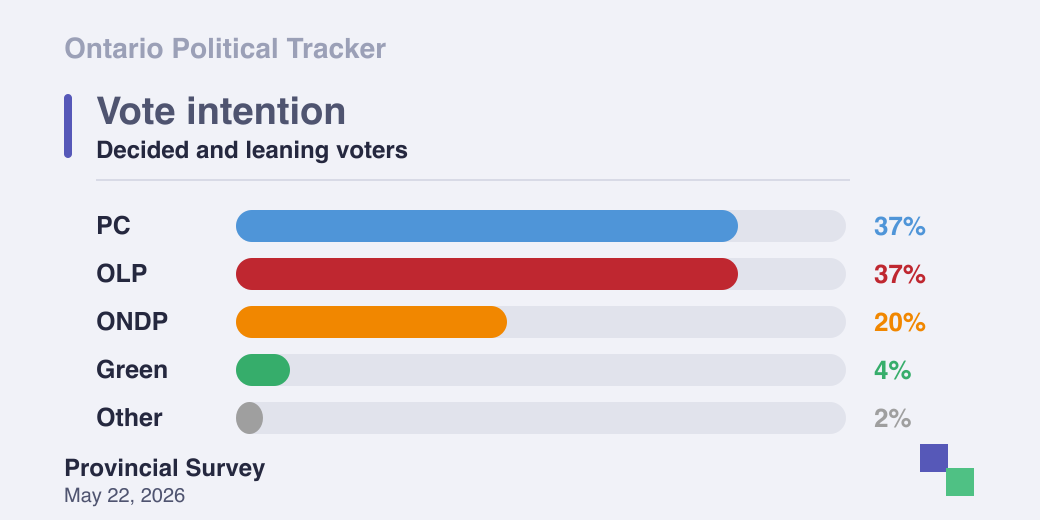
If a provincial election were held today, the PCs led by Doug Ford and the Ontario Liberal Party led by John Fraser would each receive 37% of the vote. The Ontario NDP led by Marit Stiles sits at 20%, with the Green Party at 4% and other parties at 2%.
Liaison surveyed a random sample of 1,000 Ontarians from May 15 to May 16, 2026, using Interactive Voice Recording (IVR) technology. To ensure a representative sample, participants were reached through random digit dialling (RDD) across both landline and cellular phone networks. The resulting data was weighted to match targets based on the 2021 Census. For the total sample, the margin of error is ±3.1 percentage points, 19 times out of 20.
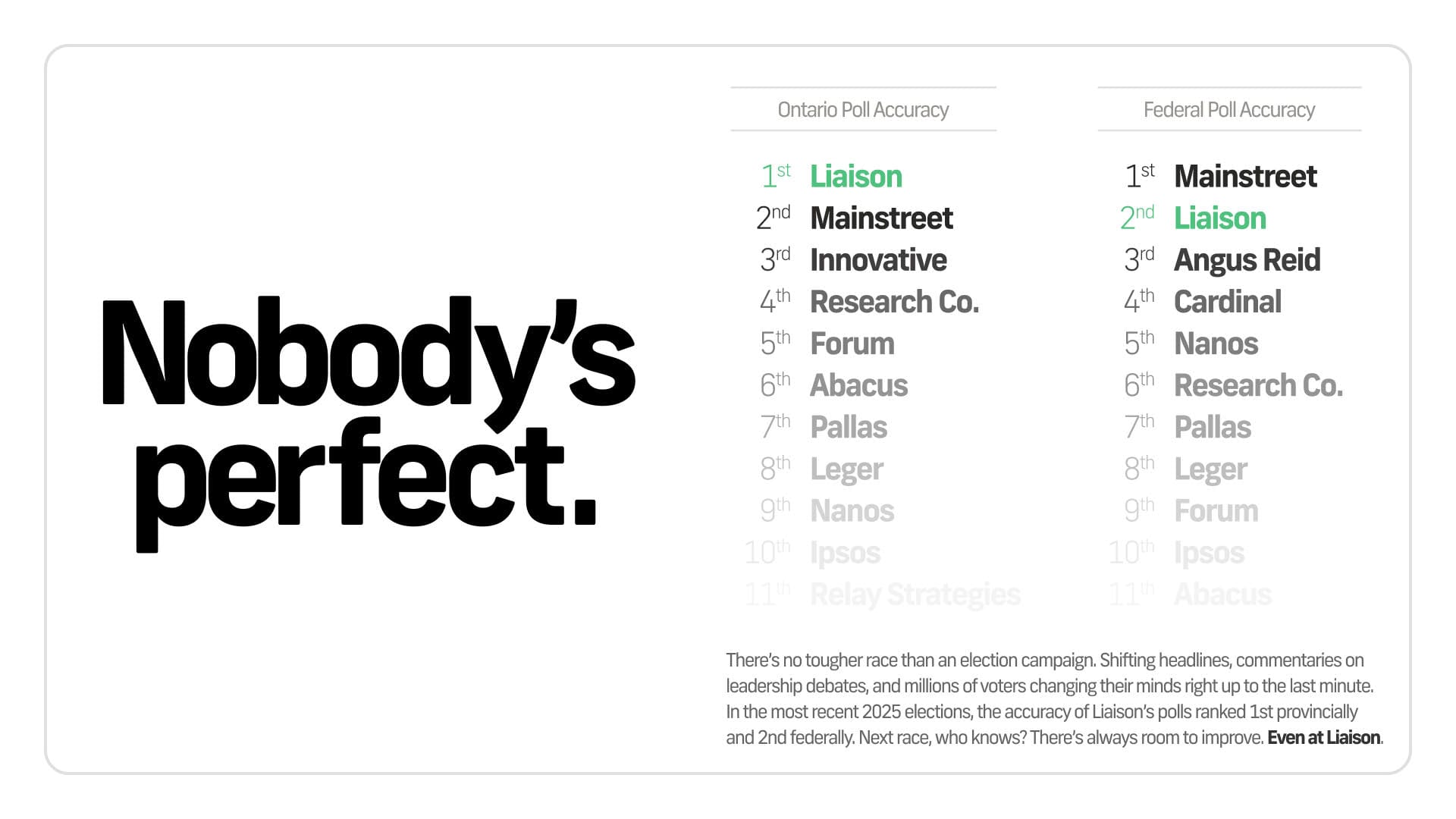
Liaison was ranked #1 for accuracy in Ontario in 2025, and #2 nationally in the 2025 federal election.
David Valentin, Principal at Liaison Strategies, said the following:
"The Ontario race is tied. The PCs have clawed back a point and the Liberals have given one back, but the larger story is that Ford’s party is still well below where it was for most of our tracking."
"The Liberals lead in the 416 and the 905, while the PCs continue to perform best in Eastern and Southwestern Ontario. The NDP remains competitive in the North and South Central, Hamilton and Niagara. In other words, this is not a province-wide wave for anyone. It is a very regionalized, very unsettled race."
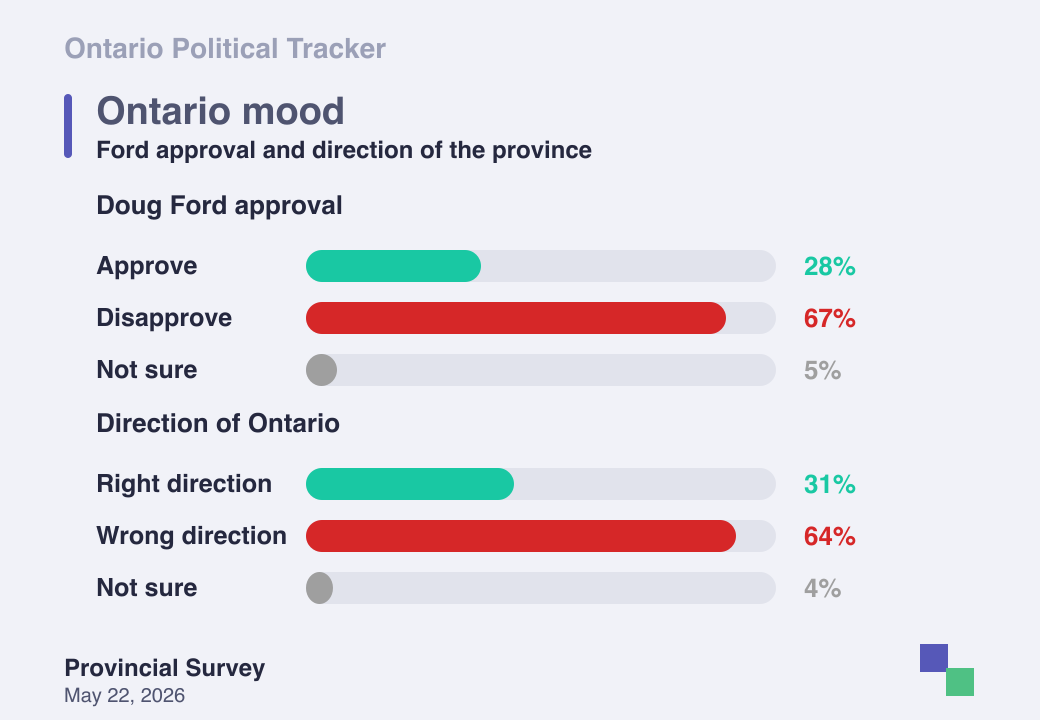
"Ford’s approval remains deeply underwater. Just 28% approve of the job he is doing as Premier, while 67% disapprove. Direction of the province is no better: 64% say Ontario is headed in the wrong direction, compared to 31% who say it is headed in the right direction."
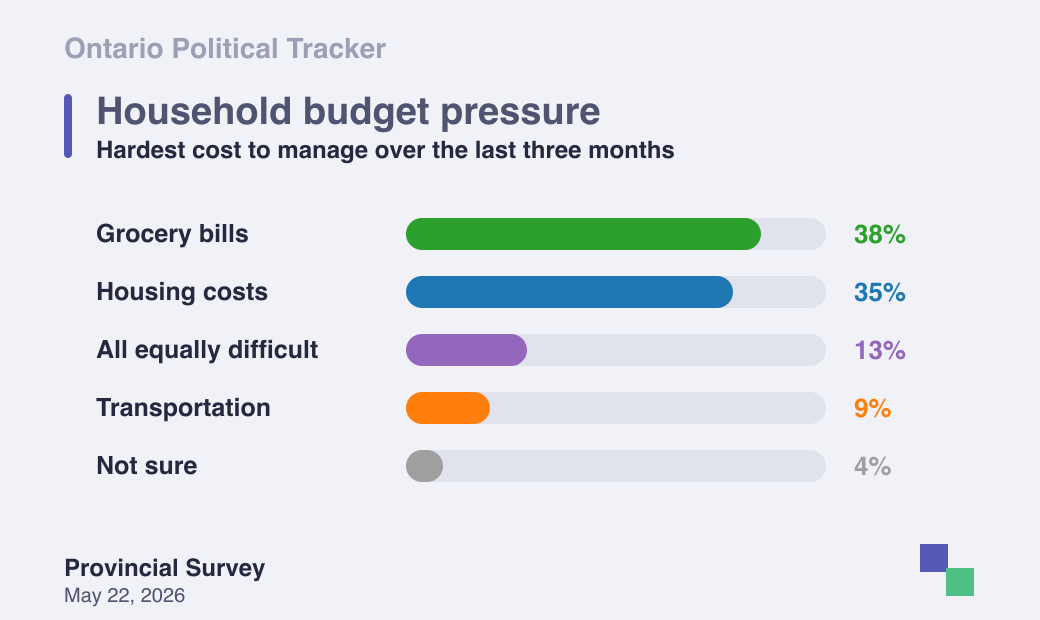
"Cost of living is the centre of this survey. When Ontarians are asked what has been hardest to manage in their household budget, groceries come first at 38%, followed closely by housing at 35%. Younger Ontarians are much more likely to cite housing, while older Ontarians are more likely to point to groceries."
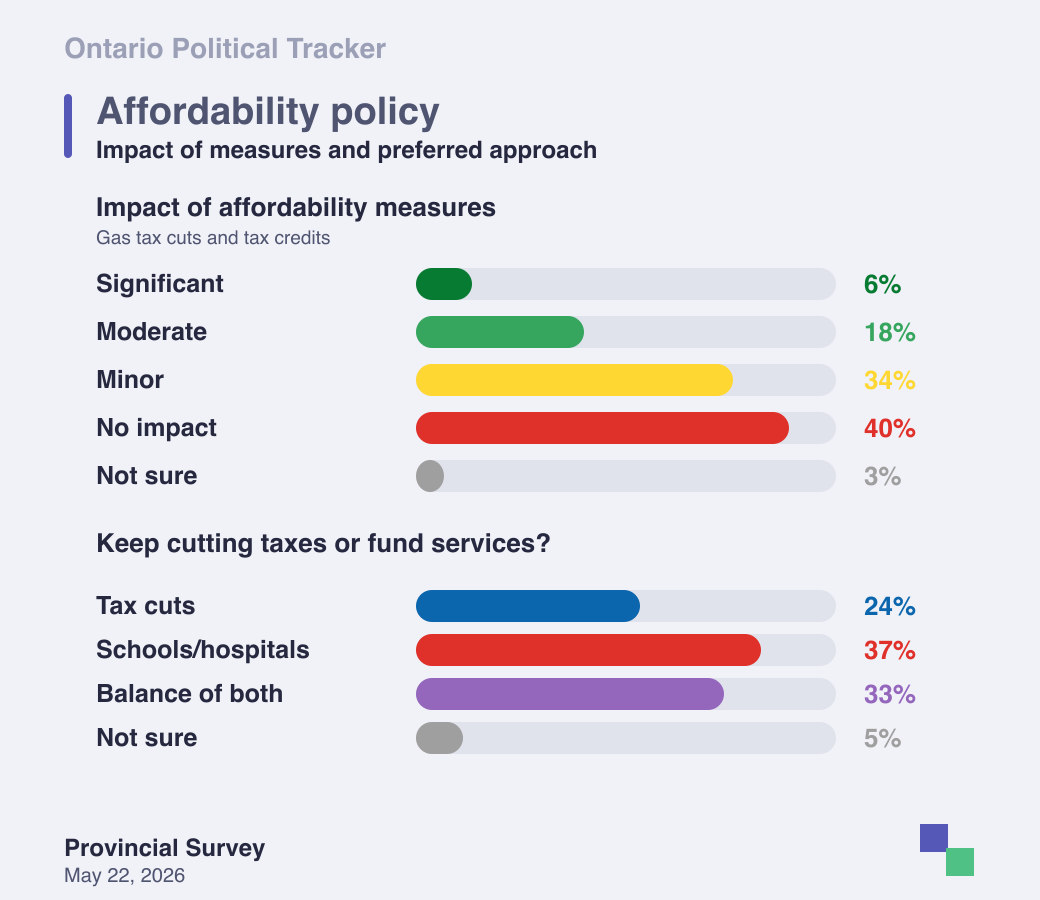
"The government’s affordability measures are not breaking through in a meaningful way. Only 6% say measures like gas tax cuts and tax credits have had a significant impact on their personal finances. Another 18% say they have had a moderate impact, while 74% say the impact has been minor or nonexistent."
"When voters are asked whether government should keep cutting taxes or redirect that money into schools and hospitals, only 24% choose tax cuts. A larger share, 37%, choose public services, while 33% want a balance of both. That is a warning sign for the government cutting taxes alone will not satisfy the electorate."
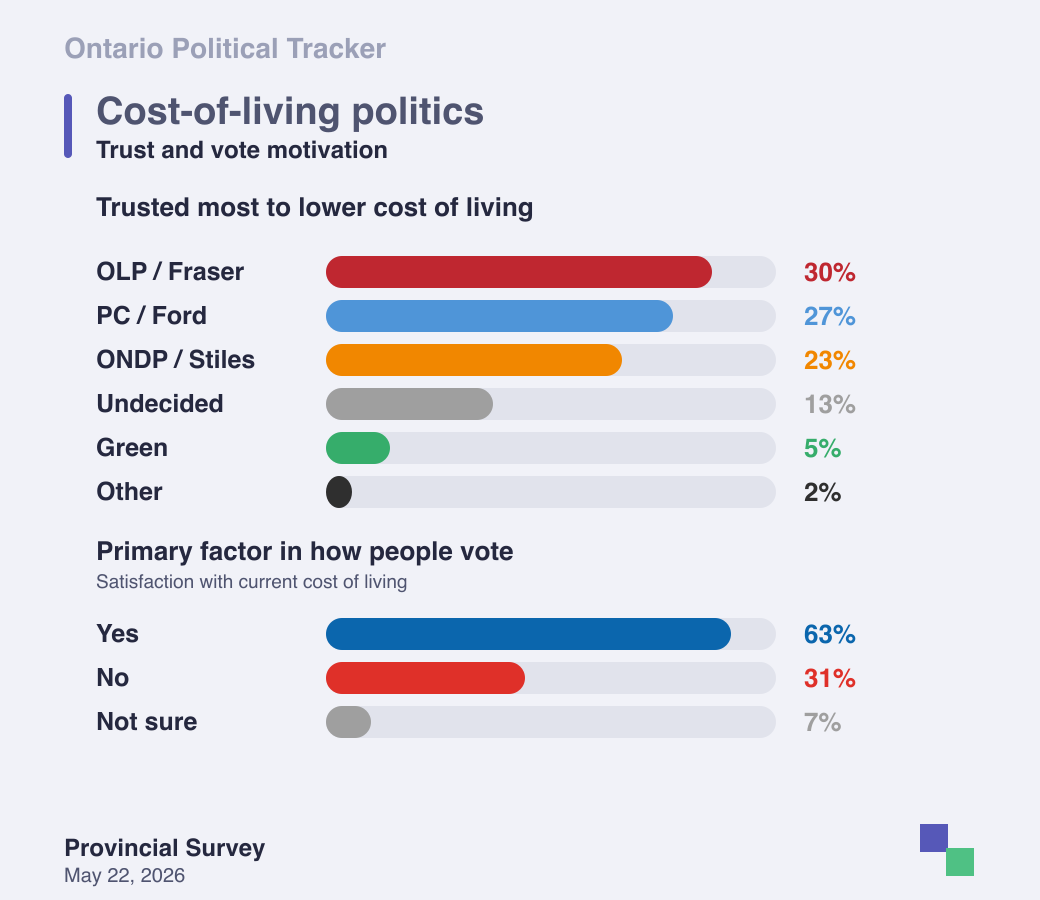
"On who voters trust most to lower the cost of living, the Liberals are narrowly ahead at 30%, followed by the PCs at 27% and the NDP at 23%. No party has a commanding advantage, but the PCs no longer own the affordability issue."
"Finally, 63% of Ontarians say their satisfaction or dissatisfaction with the cost of living would be the primary factor in how they vote. That makes affordability not just an issue in this race, but potentially the ballot question."
About Liaison Strategies
Liaison is a member of the Canadian Research Insights Council (CRIC), Canada’s voice of the research, analytics, and insights profession both domestically and globally.
