

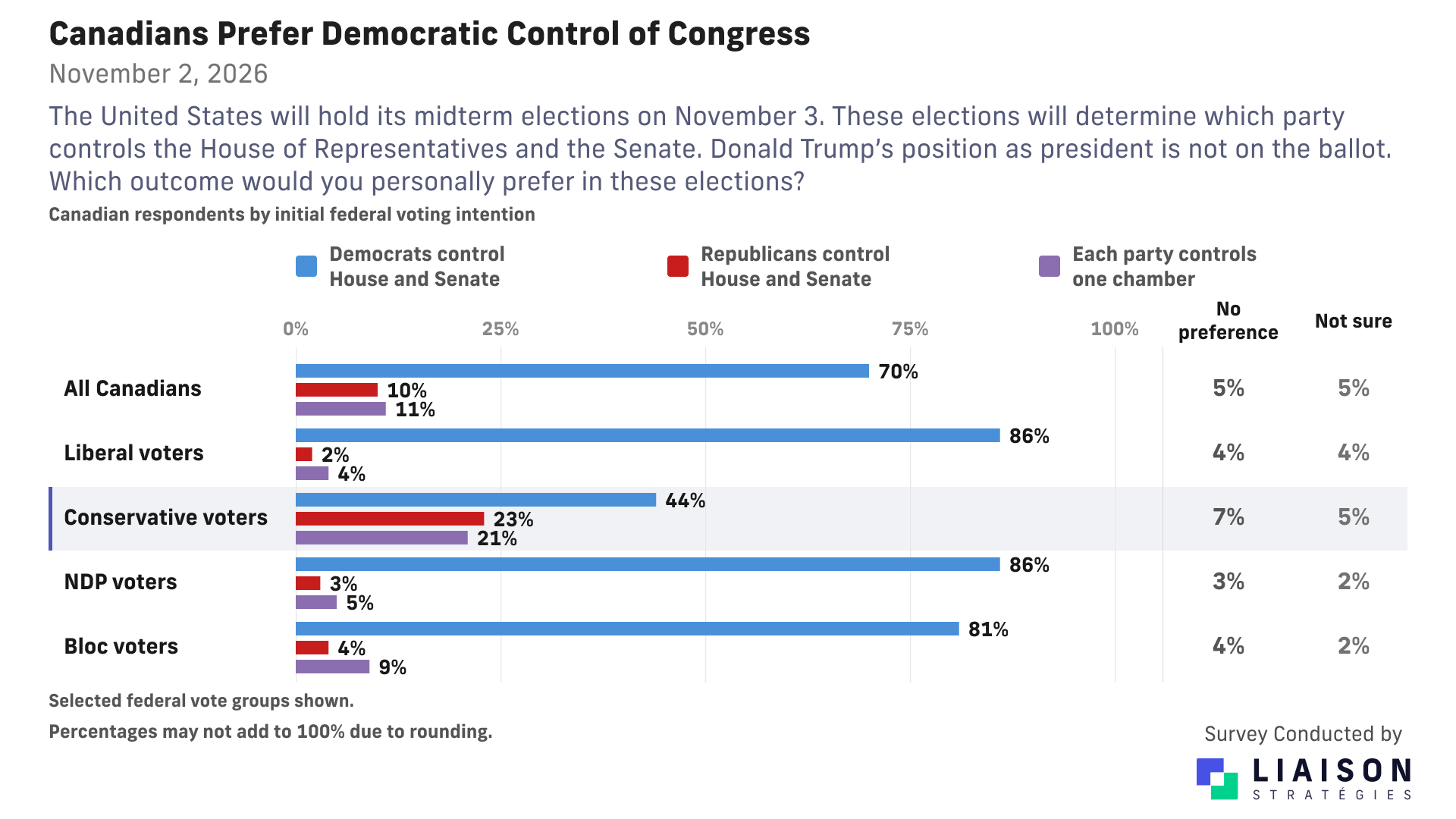
November 2, 2026 (Toronto, ON) - The latest Liaison Strategies National Tracker puts the Liberals at 45% and the Conservatives at 30% among decided and leaning voters, restoring a 15-point Liberal lead. Ahead of the American midterm elections, 70% of Canadians would prefer Democrats to control both the House of Representatives and the Senate.
Liaison surveyed a random sample of 1,000 Canadians from October 18 to October 31, 2026, using Interactive Voice Recording (IVR) technology. Participants were reached through random digit dialling (RDD) across both landline and cellular phone networks. The resulting data was weighted to match targets based on the 2021 Census. For the total sample, the margin of error is +/- 3.1 percentage points, 19 times out of 20, and is higher for subsamples.
This rolling survey combines two weeks of interviews; consecutive weekly releases share one week of sampling. Results may not add to 100% due to rounding.
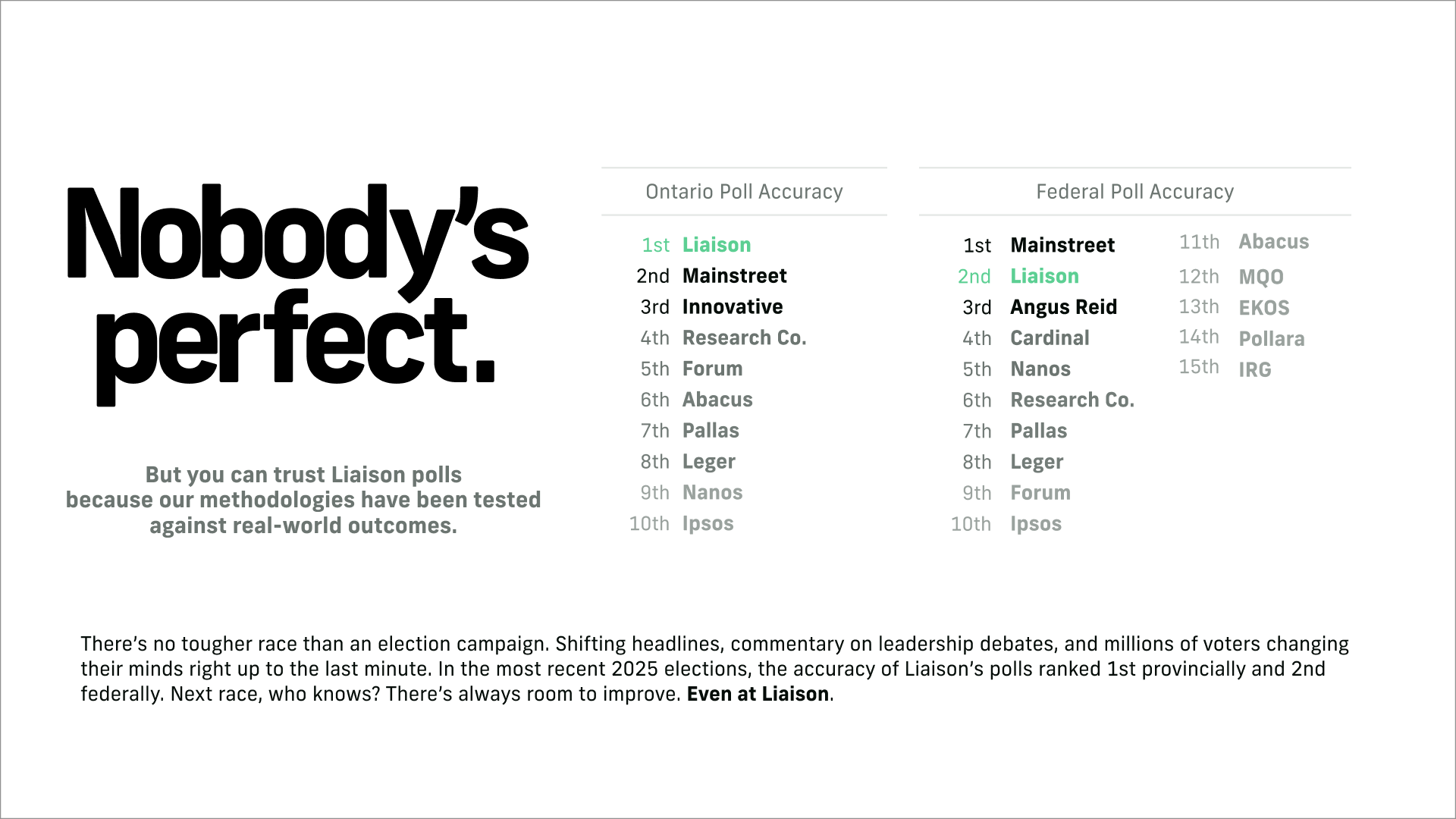
Liaison Strategies is one of the most accurate polling firms in Canada. It ranked #1 in accuracy in the 2025 Ontario election and #2 nationally in the 2025 federal election. Liaison is a member of the Canadian Research Insights Council.
David Valentin, Principal at Liaison Strategies, said:
"Canadians have a clear preference for who controls Congress. Seventy per cent want Democrats to win both chambers, compared with 10% who want Republicans to control both. Another 11% prefer each party to control one chamber."
"The preference extends beyond people who vote Liberal or NDP. Among Conservative voters, 44% would prefer Democrats to control both chambers, compared with 23% who prefer Republicans and 21% who want divided control."
"Asked separately what would be best for Canada, 65% choose Democratic control of both chambers and 8% choose Republican control. Even among Conservative voters, Democrats lead on that question by 41% to 22%."
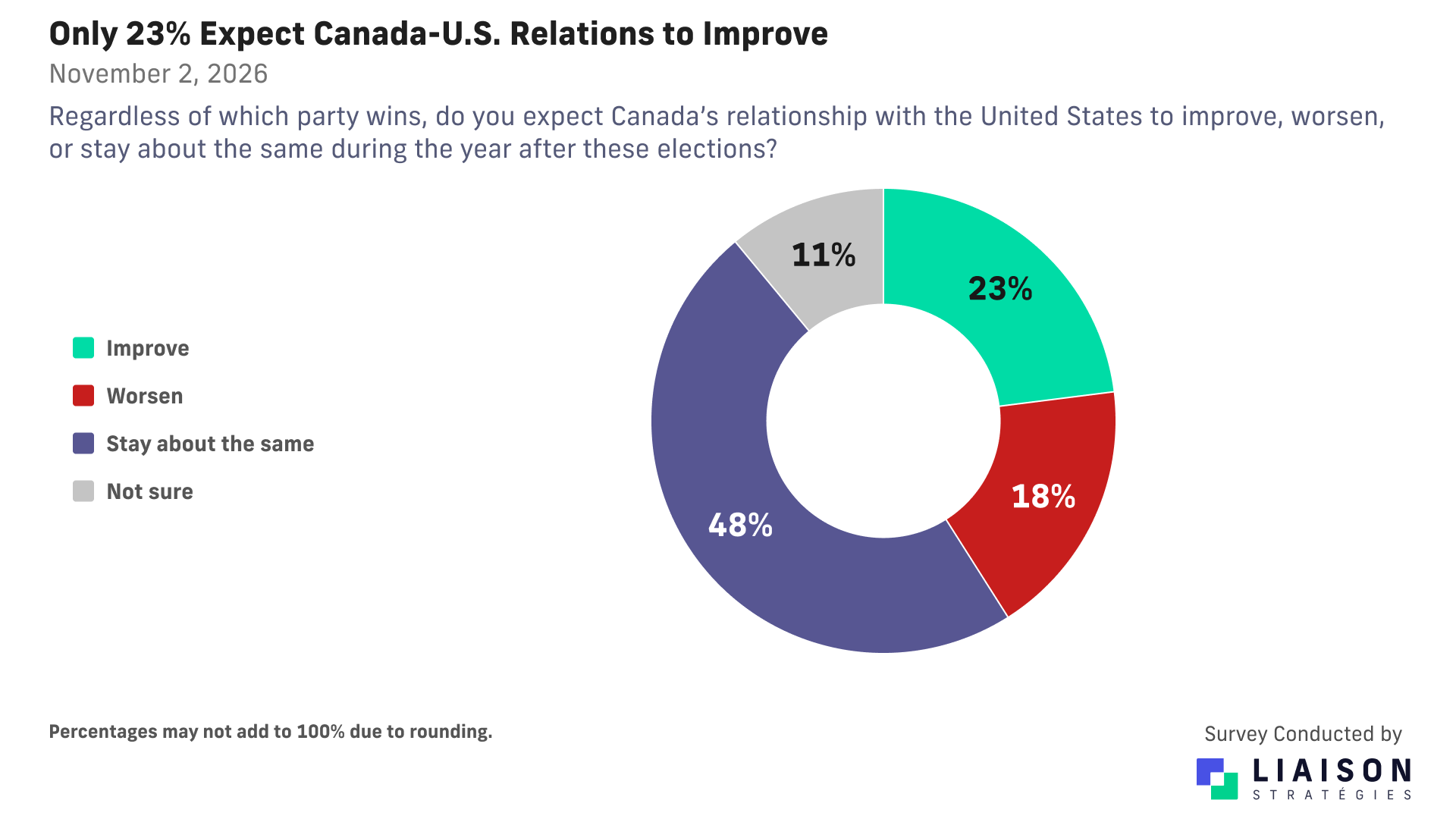
"But wanting a Democratic victory does not mean expecting relations with the United States to improve. Regardless of who wins, just 23% expect the relationship to get better in the following year. Forty-eight per cent expect it to stay about the same and 18% expect it to worsen. Canadians have a preferred outcome, but most are not predicting better relations afterwards."
"Seventy-three per cent think the elections will make at least some difference to Canada's relationship with the United States. Sixty-six per cent think Democratic control of at least one chamber would limit Trump's agenda a great deal or somewhat. Only 22% say a great deal. Expecting Congress to constrain him is different from expecting it to stop him."
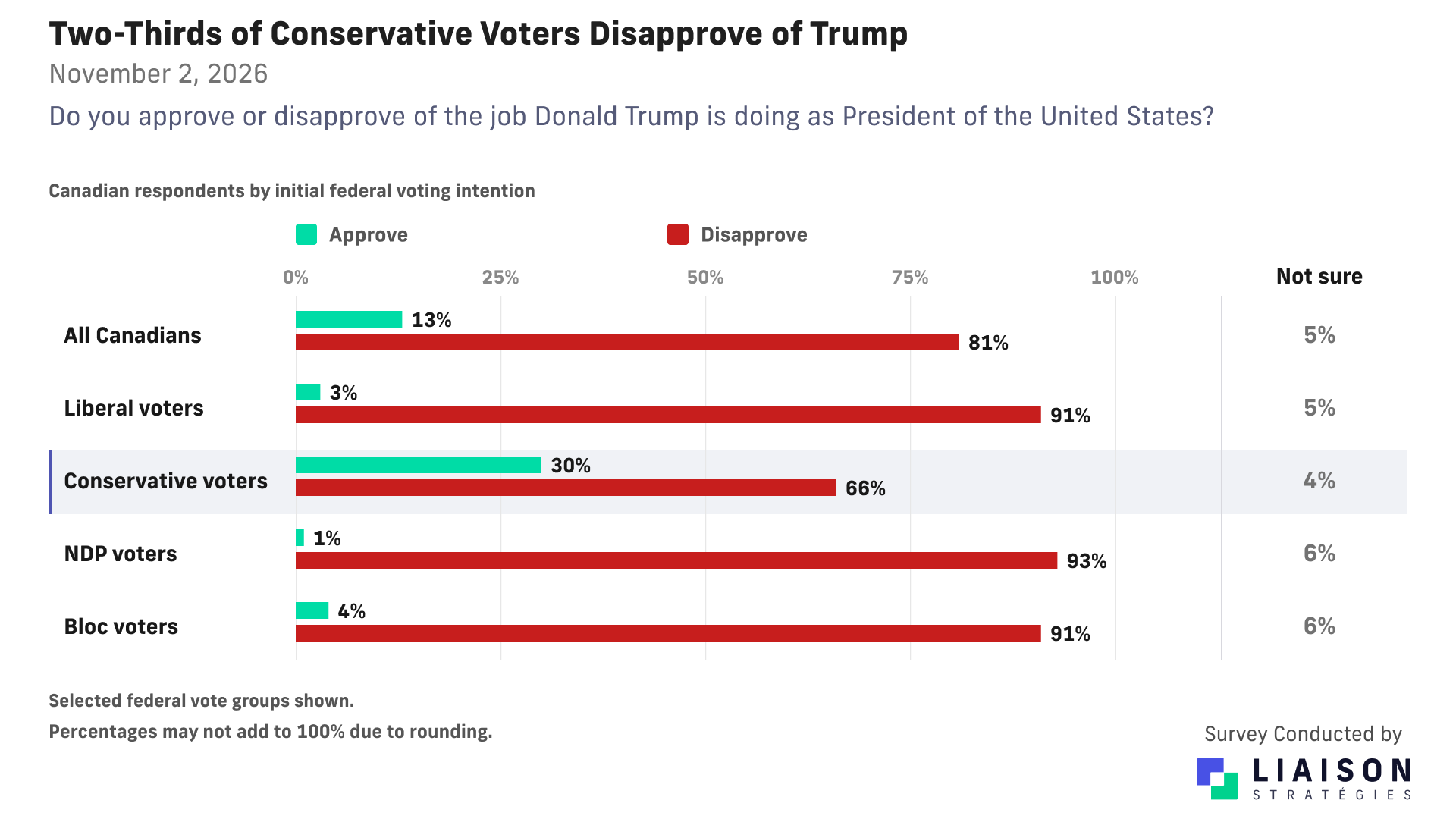
"Trump is deeply unpopular in Canada. Thirteen per cent approve of his performance and 81% disapprove, including 64% who strongly disapprove. Among Conservative voters, 30% approve and 66% disapprove. Even in that group, disapproval is more than twice approval."
"The interest is substantial, but uneven. Sixty per cent are following the midterms very or somewhat closely. That rises to 82% among Canadians aged 65 and older, compared with 38% among those aged 18 to 34. Younger Canadians also prefer Democrats, but they are much less likely to be following the contest."
"At home, the recent narrowing between the Liberals and Conservatives has paused. The Liberals are up one point to 45% and the Conservatives are down one to 30%, widening the gap from 13 points to 15. The NDP remains at 14%, followed by the Bloc at 6%, the Greens and People's Party at 2% each, and other parties at 1%."

"Ontario has moved back towards the Liberals, who lead 48% to 33%, compared with 46% to 35% last week. Alberta has moved the other way: the Conservatives lead 46% to 39%, after a one-point gap last week."
"Carney's approval is 64%, down from 65%, with 28% disapproving. Poilievre's favourable rating is 33%, down from 35%, while 53% view him unfavourably. The Conservatives' three weeks of ballot gains have not continued in this update, and neither has the recent improvement in their leader's personal ratings."
-30-
Detailed Poll Report:
Detailed Tables:
2026.11.02 National Tables - Tracker and US Midterms
About Liaison Strategies
Liaison Strategies is a national public opinion research firm. With 13 years of experience in Canadian polling, David Valentin, principal, has fielded hundreds of projects at the municipal, provincial and federal levels and appeared across Canadian media to discuss insights. Liaison is a member of the Canadian Research Insights Council (CRIC), Canada's voice of the research, analytics, and insights profession both domestically and globally.
About Liaison Strategies
Liaison is a member of the Canadian Research Insights Council (CRIC), Canada’s voice of the research, analytics, and insights profession both domestically and globally.
