

Federal Tracker: Liberals 45%, Conservatives 29%; Poilievre Ratings Worsen
October 12, 2026 (Toronto, ON) - The latest Liaison Strategies Weekly Federal Tracker finds the Liberals at 45% and the Conservatives at 29% among decided and leaning voters, a 16-point Liberal lead. The Conservative vote has edged up from last week's tracking low, even as Pierre Poilievre's personal ratings have weakened again.
Liaison surveyed a random sample of 1,263 Canadians from September 27 to October 10, 2026, using Interactive Voice Recording (IVR) technology. Participants were reached through random digit dialling (RDD) across both landline and cellular phone networks. The resulting data was weighted to match targets based on the 2021 Census. For the total sample, the margin of error is +/- 2.8 percentage points, 19 times out of 20, and is higher for subsamples. Results may not add to 100% due to rounding. This rolling survey combines two weeks of interviews; consecutive weekly releases share one week of sampling.
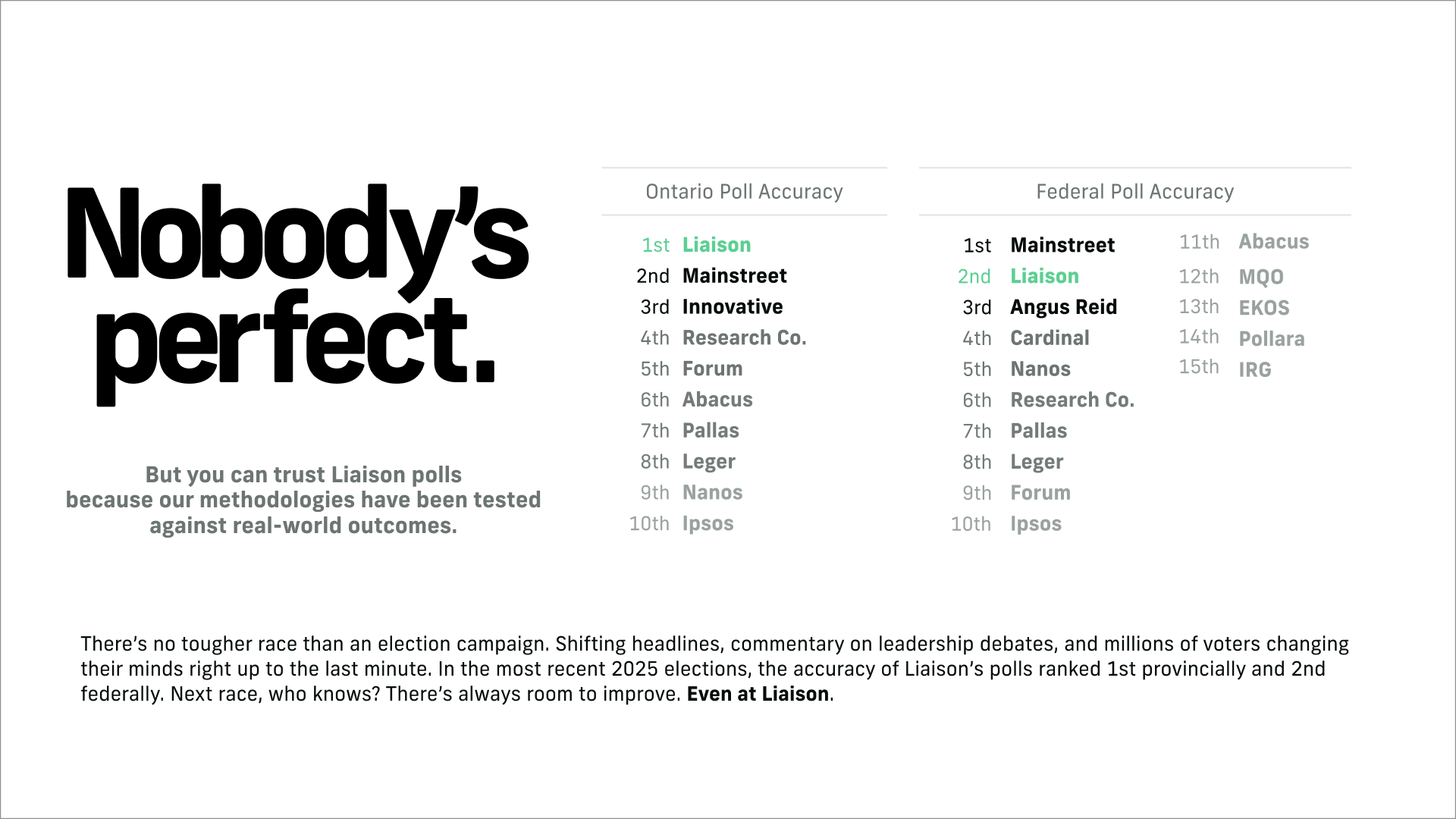
Liaison Strategies is one of the most accurate polling firms in Canada. It ranked #1 in accuracy in the 2025 Ontario election and #2 nationally in the 2025 federal election. Liaison is a member of the Canadian Research Insights Council.
David Valentin, Principal at Liaison Strategies, said:
"The Conservatives have recovered a point from last week's 28%, while the Liberals have slipped a point from 46%. That narrows the gap from 18 points to 16. The Conservatives are off their low, but still below 30% and well behind the Liberals."

"The more uncomfortable result for the Conservatives is Poilievre's personal standing. His favourable rating has gone from 36% on September 28 to 34% last week and 32% now. Over the same releases, his unfavourable rating has risen from 51% to 53% to 55%. That leaves a 23-point gap against him, compared with 15 points two releases ago. A one-point improvement on the ballot has not stopped his personal ratings from deteriorating."

"Ontario and Quebec account for much of the difficulty. In Ontario, 62% view Poilievre unfavourably and 29% favourably. In Quebec, those figures are 63% and 16%. The Liberals lead the Conservatives 49% to 33% in Ontario. In Quebec, the Liberals have 44%, the Bloc 25% and the Conservatives 16%. The party needs to win back voters in provinces where its leader faces substantial resistance."
"Carney's approval has eased to 64%, from 66%, while disapproval has risen to 29%, from 27%. He still has a 35-point advantage on that measure. That is a strong position and within the statistical movement we see from release to release."
"Lewis is moving in the opposite direction to Poilievre. His favourable rating has risen from 31% on September 28 to 33% last week and 35% now. His unfavourable rating has fallen from 30% to 28% to 27%. His net favourability has improved from plus one to plus eight points. Yet the NDP has remained at 15% in each of those releases. Voters are becoming more receptive to Lewis without giving his party a larger national share."
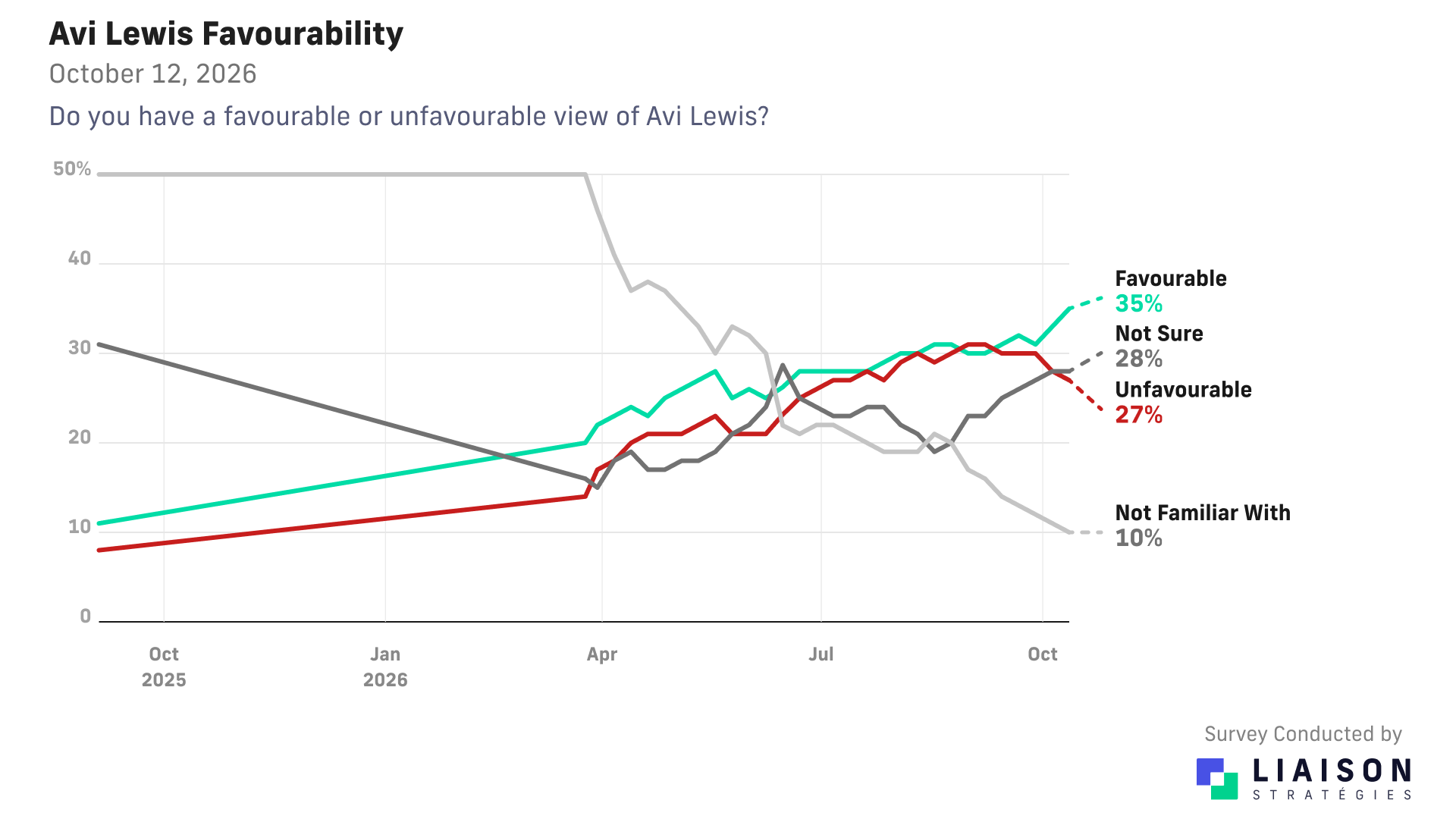
"The NDP's potential voters are particularly visible among younger Canadians. Among decided and leaning voters aged 18 to 34, the NDP has 25%, almost level with the Conservatives at 26%, while the Liberals have 36%. Lewis is viewed favourably by 45% of respondents in that age group. There is an audience for him, but liking the leader and choosing the party are different decisions."
"The Liberal position is much stronger among seniors, where the party has 57%, compared with 25% for the Conservatives and 8% for the NDP. Among women, the Liberals lead 50% to 24%; among men, they lead 42% to 35%. For the Conservatives, a competitive result among one group is not enough to offset the size of the deficits elsewhere."
"Alberta gives the Conservatives a 45% to 38% advantage. Manitoba and Saskatchewan combined are nearly level, at 40% Conservative and 39% Liberal. In British Columbia, the Liberals have 42%, the Conservatives 28% and the NDP 24%. Those regional samples are smaller and more variable, but they show why there is no single western result that describes the national race."
"The rest of the decided and leaning vote is unchanged: the Bloc has 6%, the Greens and the People's Party have 2% each, and other parties have 1%. On the initial vote question, the Liberals have 39%, the Conservatives 24% and the NDP 13%, with 15% undecided. The immediate question is whether either opposition party can turn a better result for itself into a sustained reduction in the Liberal lead."
-30-
Detailed Poll Report:
Detailed Tables:
About Liaison Strategies
Liaison Strategies is a national public opinion research firm. With 13 years of experience in Canadian polling, David Valentin, principal, has fielded hundreds of projects at the municipal, provincial and federal levels and appeared across Canadian media to discuss insights. Liaison is a member of the Canadian Research Insights Council (CRIC), Canada's voice of the research, analytics, and insights profession both domestically and globally.
About Liaison Strategies
Liaison is a member of the Canadian Research Insights Council (CRIC), Canada’s voice of the research, analytics, and insights profession both domestically and globally.
