

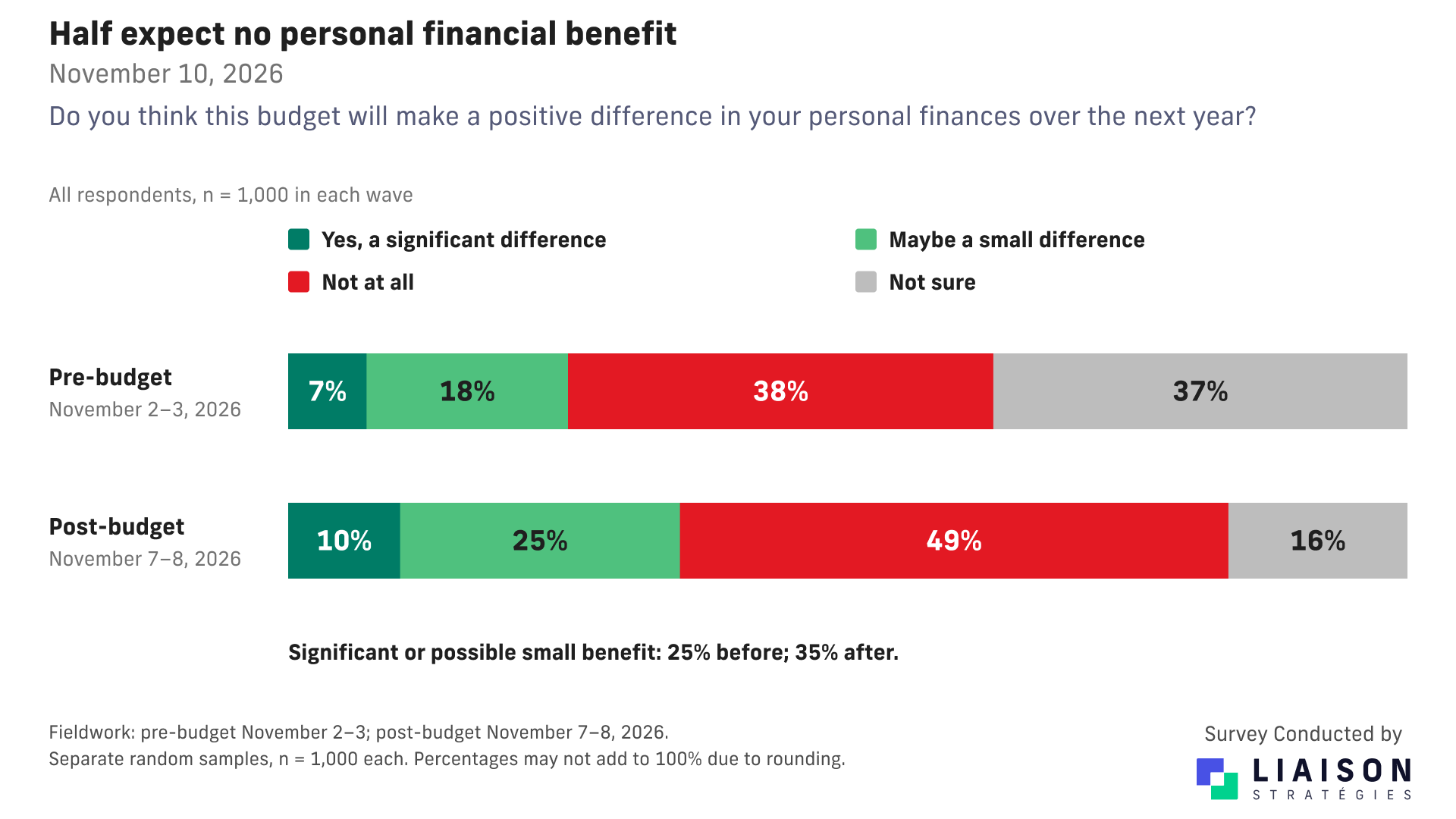
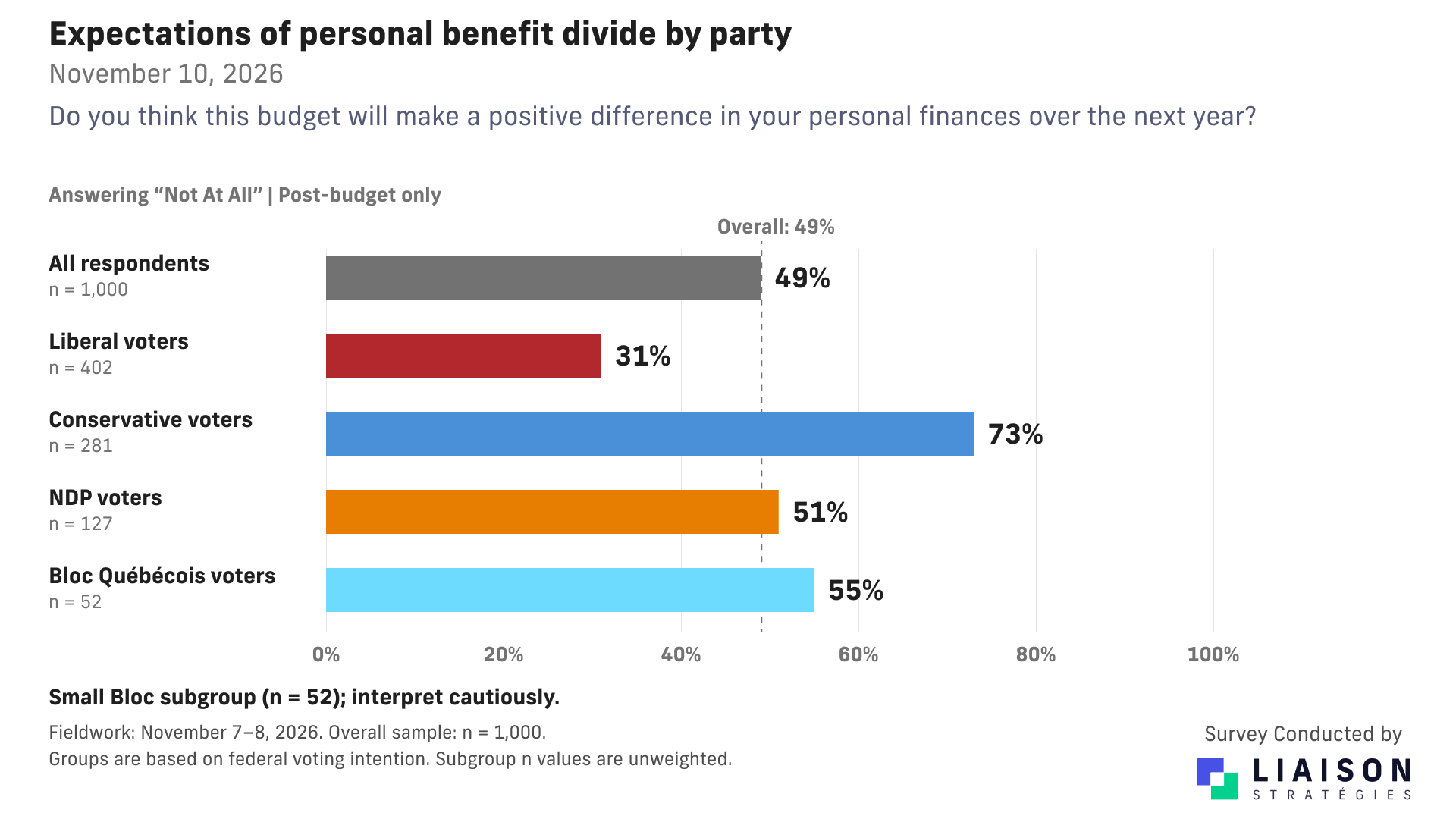
November 10, 2026 (Toronto, ON) - A new Liaison Strategies pre- and post-budget study finds 49% of Canadians do not expect the federal budget to make any positive difference to their personal finances, up from 38% beforehand. Nearly half also say the government is spending too much, while 63% say opposition parties are mostly playing politics in their response.
Liaison surveyed two separate random samples of 1,000 Canadians, before the budget from November 2 to November 3, 2026, and after the budget from November 7 to November 8, 2026, using Interactive Voice Recording (IVR) technology. Participants were reached through random digit dialling (RDD) across both landline and cellular phone networks. The data in each survey was weighted by age, gender and region to match targets based on the 2021 Census. For each total sample, the margin of error is +/- 3.1 percentage points, 19 times out of 20, and is higher for subsamples. Results may not add to 100% due to rounding. These are separate samples, not re-interviews with the same respondents.
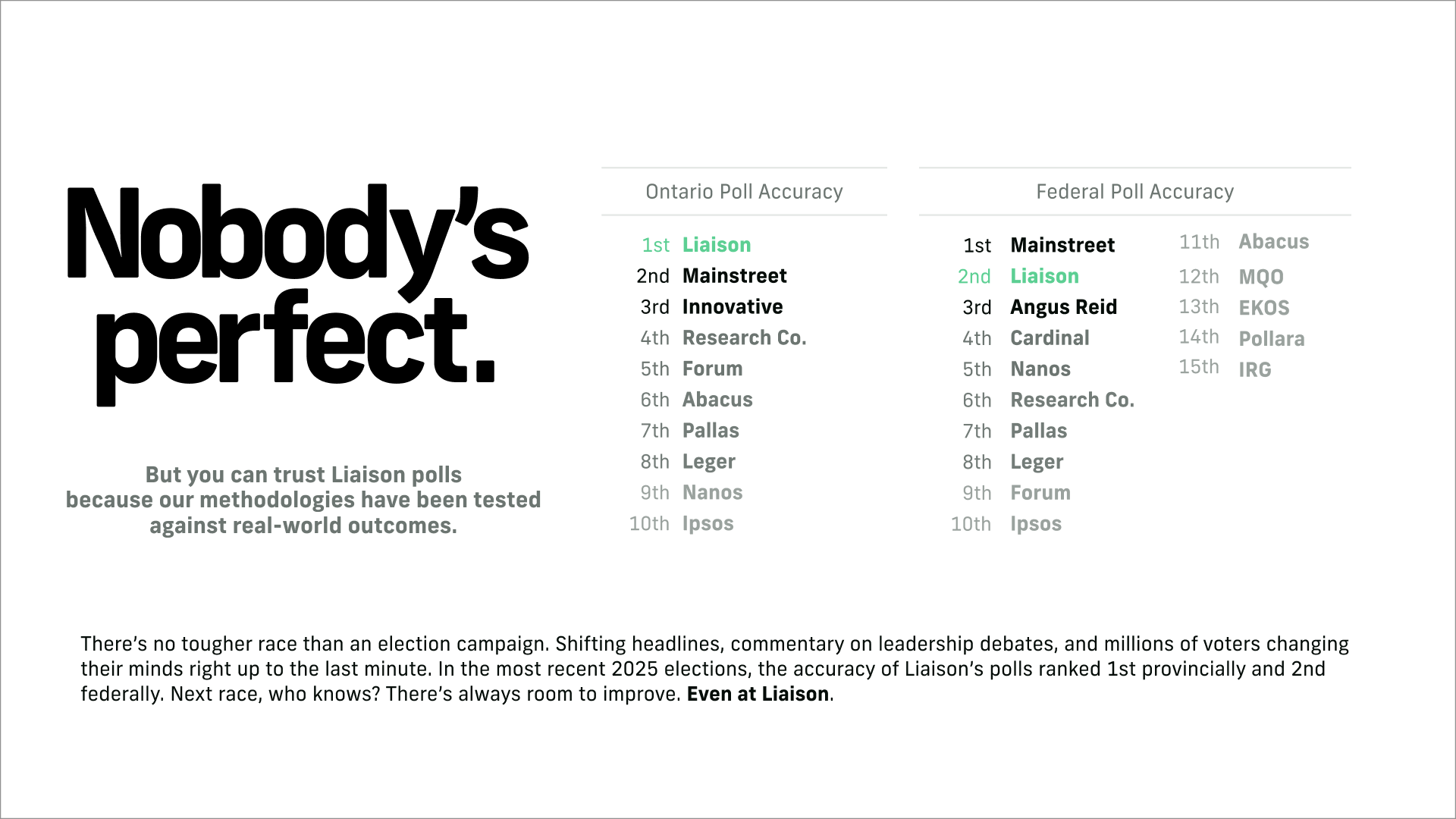
Liaison Strategies is one of the most accurate polling firms in Canada. It ranked #1 in accuracy in the 2025 Ontario election and #2 nationally in the 2025 federal election. Liaison is a member of the Canadian Research Insights Council.
David Valentin, Principal at Liaison Strategies, said:
"The government has work to do explaining what this budget means for people's own finances. Forty-nine per cent expect no positive difference over the next year. Only 10% expect a significant difference, while 25% say maybe a small difference and 16% are unsure."
"The biggest change is that fewer Canadians are waiting to form an opinion. Before the budget, 37% were unsure about its effect on their finances. That is now 16%. Both the share expecting no benefit and the share seeing at least a possible benefit have grown. This is not simply a shift from positive to negative."
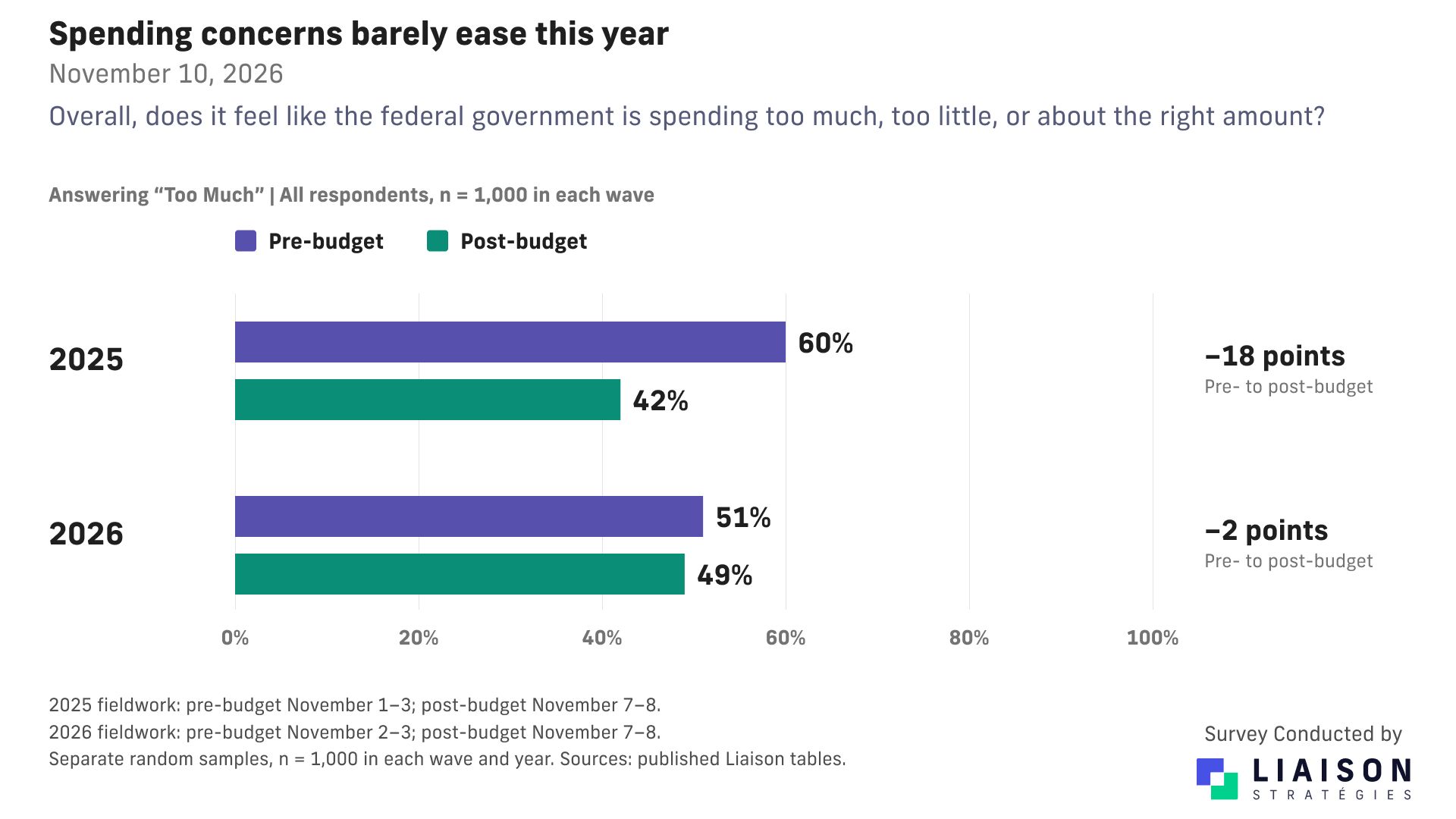
"The spending numbers have barely budged. Forty-nine per cent say the government is spending too much, compared with 51% before the budget. Thirty per cent say spending is about right, up from 25%, while 13% say it is too little, compared with 14% beforehand. There is some improvement for the government, but little change in the share that thinks it is overspending."
"That is quite different from last year's result. In our 2025 pre- and post-budget surveys, the share saying the government was spending too much fell from 60% to 42%. This year, it has gone from 51% to 49%. The government started with fewer people concerned about overspending than last year, but it has not recorded anything like the same easing after this budget."
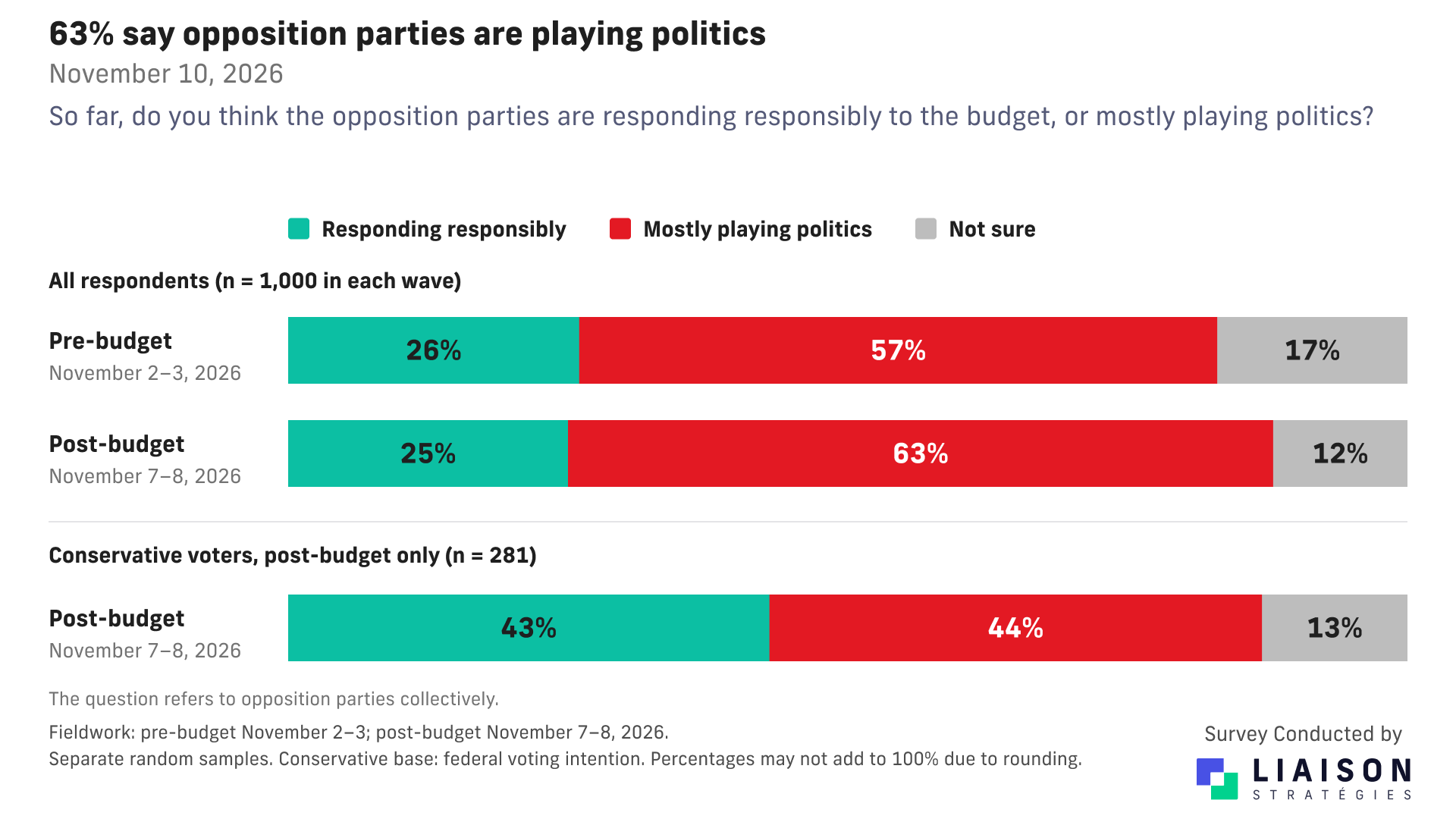
"For the opposition, there is a warning too. Sixty-three per cent say opposition parties are mostly playing politics, up from 57% before the budget. Just 25% say they are responding responsibly. Doubts about the budget are not translating into widespread approval of how the opposition is handling it."
"Even Conservative voters are almost evenly divided on the opposition's response: 43% say it is responsible and 44% say it is mostly playing politics. At the same time, 73% of Conservative voters think the government spends too much, compared with 30% of Liberal voters. The opposition has an audience for criticism of spending. That does not mean those voters like the response they are seeing."
"The partisan divide is just as clear when people consider their own finances. Seventy-three per cent of Conservative voters expect no positive difference from the budget, compared with 31% of Liberal voters. Among Liberals, 18% expect a significant difference and 33% say maybe a small difference. Even within the government's own support, expectations are more often tentative than emphatic."
"Canadians are also forming a clearer view of what the budget means for the country's finances, without becoming more positive on balance. Twenty per cent expect it to make Canada's financial situation better, 33% worse and 32% mostly the same. Before the budget, those figures were 13%, 26% and 26%. The share unsure has fallen from 35% to 15%. Better and worse have both gained seven points."
"The broader economic mood remains difficult. Sixty-one per cent describe themselves as worried, pessimistic, or angry or frustrated, compared with 62% before the budget. Thirty-one per cent are optimistic or cautiously hopeful, up from 28%. Fifty-five per cent say Canada is on the wrong track, compared with 38% who say the right track. The budget has not been followed by a substantial improvement in how Canadians feel about the economy."
-30-
Detailed Poll Report:
Budget 2026 - Before and After the Budget
Detailed Post-budget Tables:
2026.11.10 Budget 2026 - Post-budget Tables
Detailed Pre-budget Tables:
2026.11.10 Budget 2026 - Pre-budget Tables
About Liaison Strategies
Liaison Strategies is a national public opinion research firm. With 13 years of experience in Canadian polling, David Valentin, principal, has fielded hundreds of projects at the municipal, provincial and federal levels and appeared across Canadian media to discuss insights. Liaison is a member of the Canadian Research Insights Council (CRIC), Canada's voice of the research, analytics, and insights profession both domestically and globally.
About Liaison Strategies
Liaison is a member of the Canadian Research Insights Council (CRIC), Canada’s voice of the research, analytics, and insights profession both domestically and globally.
