

(Toronto, ON) – A new national Liaison Strategies poll taken immediately following the federal budget reveals a mixed public reaction: perceptions of the deficit’s severity have eased, more Canadians think the spending levels are appropriate, and the Liberals have widened their lead to 8 points over the Conservatives.
That being said 58% say they are worried, pessimistic or frustrated about the Canadian economy compared to 55% pre-budget and 50% say they don't believe the budget will affect their personal finances positively.
Conducted from November 7 to 8, 2025, using Interactive Voice Response (IVR), the survey polled 1,000 Canadians. The margin of error is ±3.09 percentage points, 19 times out of 20.
Liaison Strategies is one of the most accurate polling firms in Canada. It ranked #1 in accuracy in the 2025 Ontario election and #2 nationally in the 2025 federal election. Liaison is a member of the Canadian Research Insights Council (CRIC).

David Valentin, Principal at Liaison Strategies said:
A lot has happened since our pre-budget survey. When they said a week is a lifetime in politics they weren't kidding. Keep in mind as you read the post-budget numbers that Canadians are interpreting the budget through the media and are receiving context cues from current events. A Conservative MP crossing the floor - and then another one quitting, are the headlines directly before and after the budget coverage Canadians consumed. This was not a good week for the Conservatives.
Let's start with the Prime Minister's approval which is virtually unchanged:
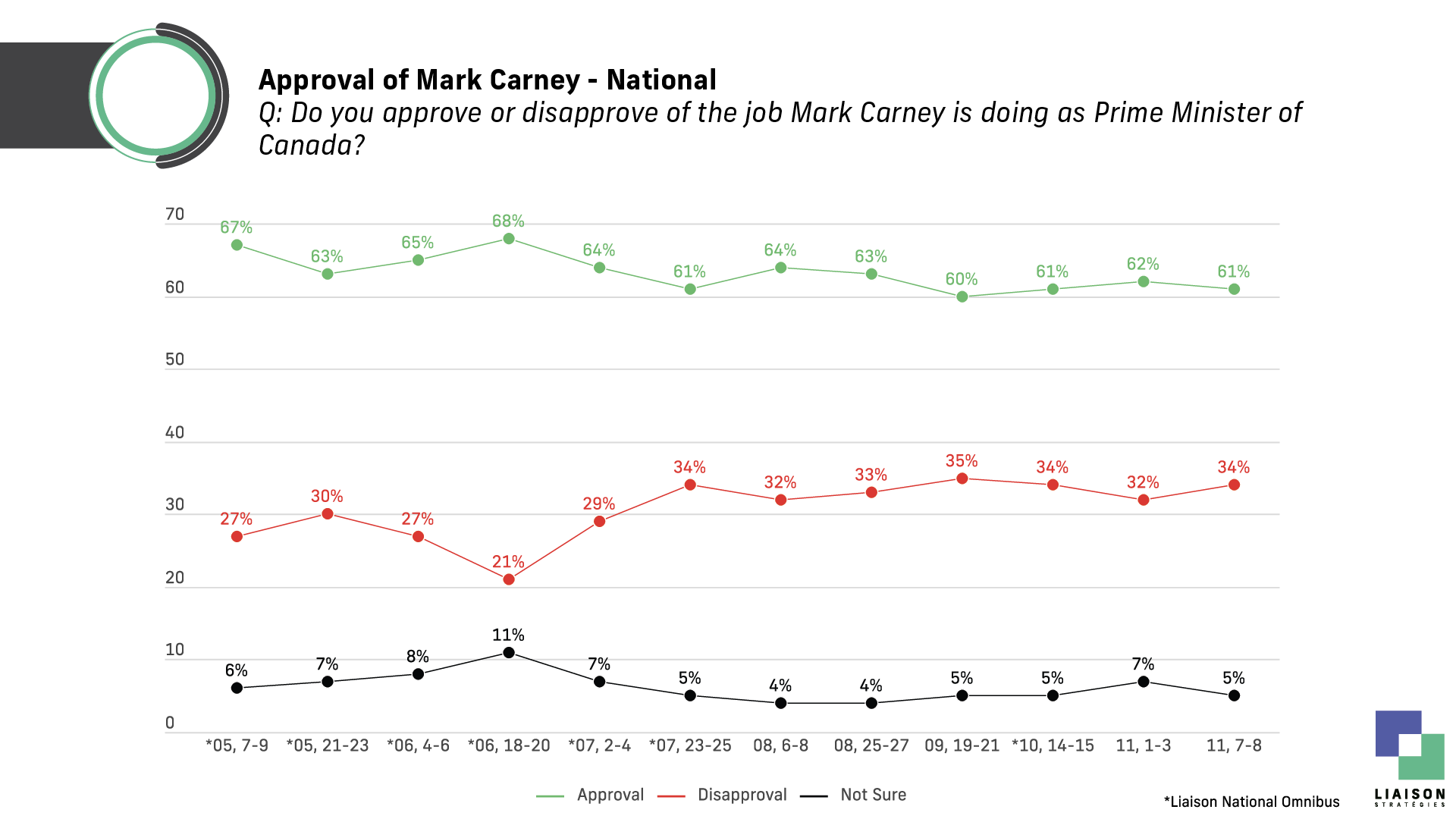
For anyone expecting the budget to dent the Prime Minister’s brand, there’s no sign of that happening yet.
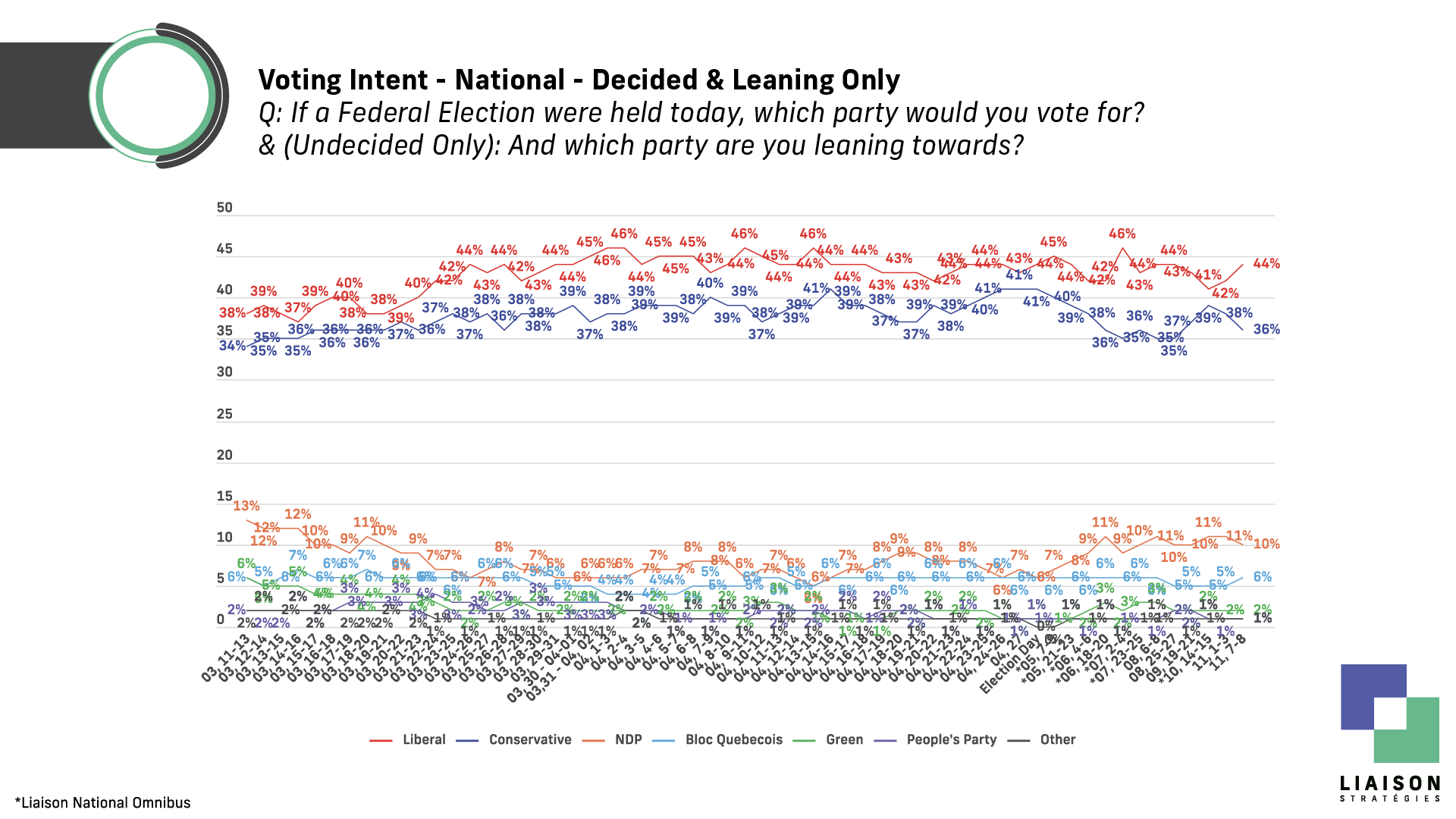
Meanwhile, if an election were held today, the Liberals would now lead by eight points and the regionals point to a majority government. While the Conservatives are still ahead in the Prairies and Alberta, the Liberals have strong leads in Atlantic Canada (+23), Quebec (+17), British Columbia (+10) and most importantly Ontario (+14).
Cautious Outlook on the Budget
To get a sense of how Canadians view this year’s federal budget, Liaison is conducting a before-and-after survey - here's the after.
Before the budget, 78 percent told us the deficit was larger. After the budget, that number softens to 65 percent in our simplified version of the question, and the share saying the deficit is “much larger” drops by 24 points.
Liberals are the most likely to say the deficit is smaller or holding steady. Conservatives overwhelmingly believe it continues to grow. Among undecided voters, 36 percent say the deficit is larger while 23 percent say it is about the same.
We know the deficit is, in fact, increasing by quite a lot. So how do we interpret these numbers? A reminder that most Canadians are not following budget coverage closely. Their views aren’t shaped by line-by-line analysis but by the wider information climate: social media, headlines, and conversations with friends, family, and co-workers.

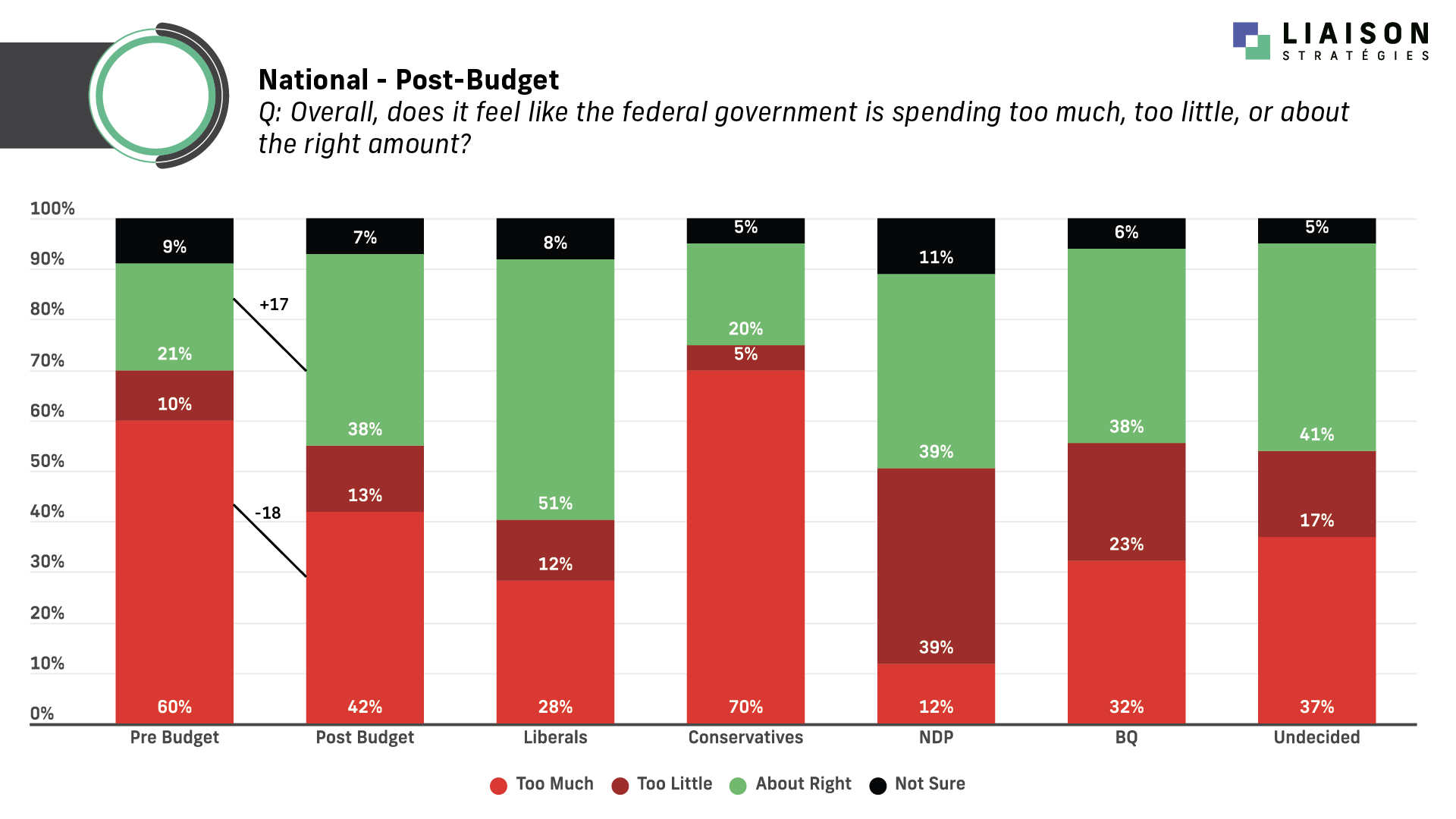
At the same time as impressions of a growing deficit ease, we also see a significant drop in the number of Canadians who say the government is overspending. A key theme of the budget was restraint, and there are signs that this part of the message is landing.
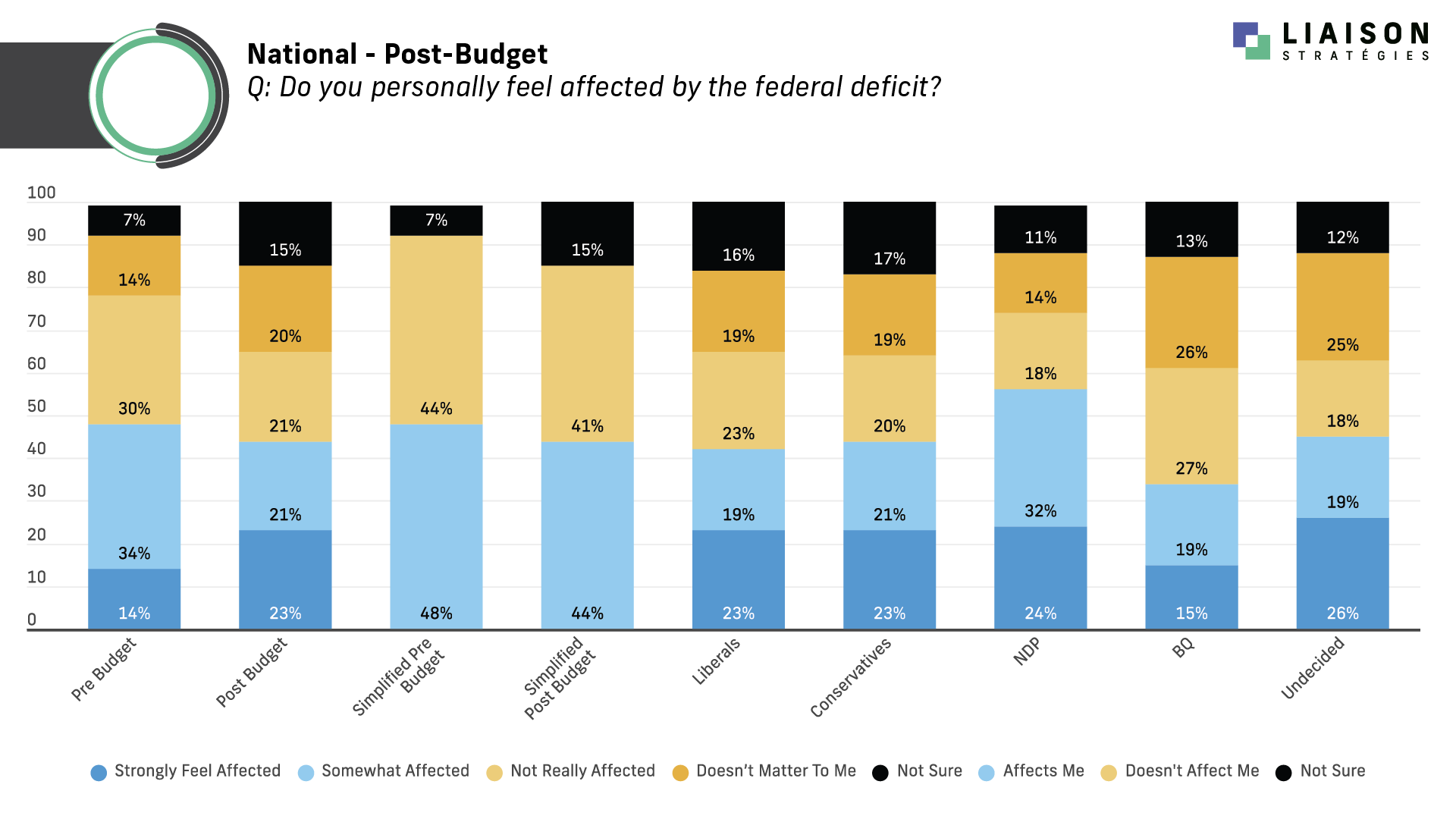
Will the deficit impact Canadians? On this front there is a little movement if we look at the simplified figures (+4 for affected, -3 for not affected) but the composition has changed. Those saying they will be strongly affected is up nine points, those saying it doesn't matter to them is up 6 points.
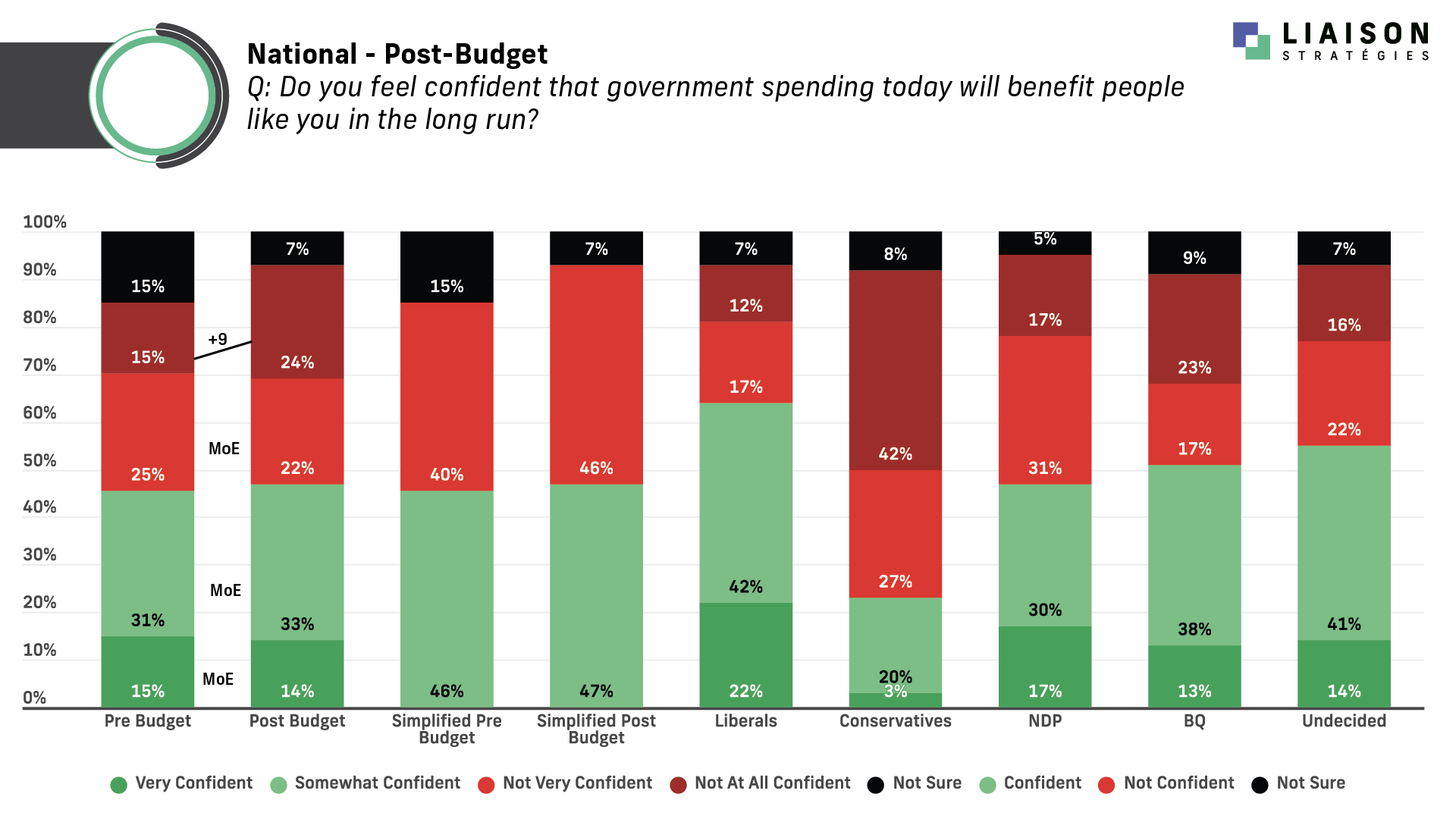
When it comes to confidence that the budget will benefit Canadians in the long run, there isn’t much movement. Where change does occur, it cuts against the government, with an additional nine points shifting into “not at all confident.”
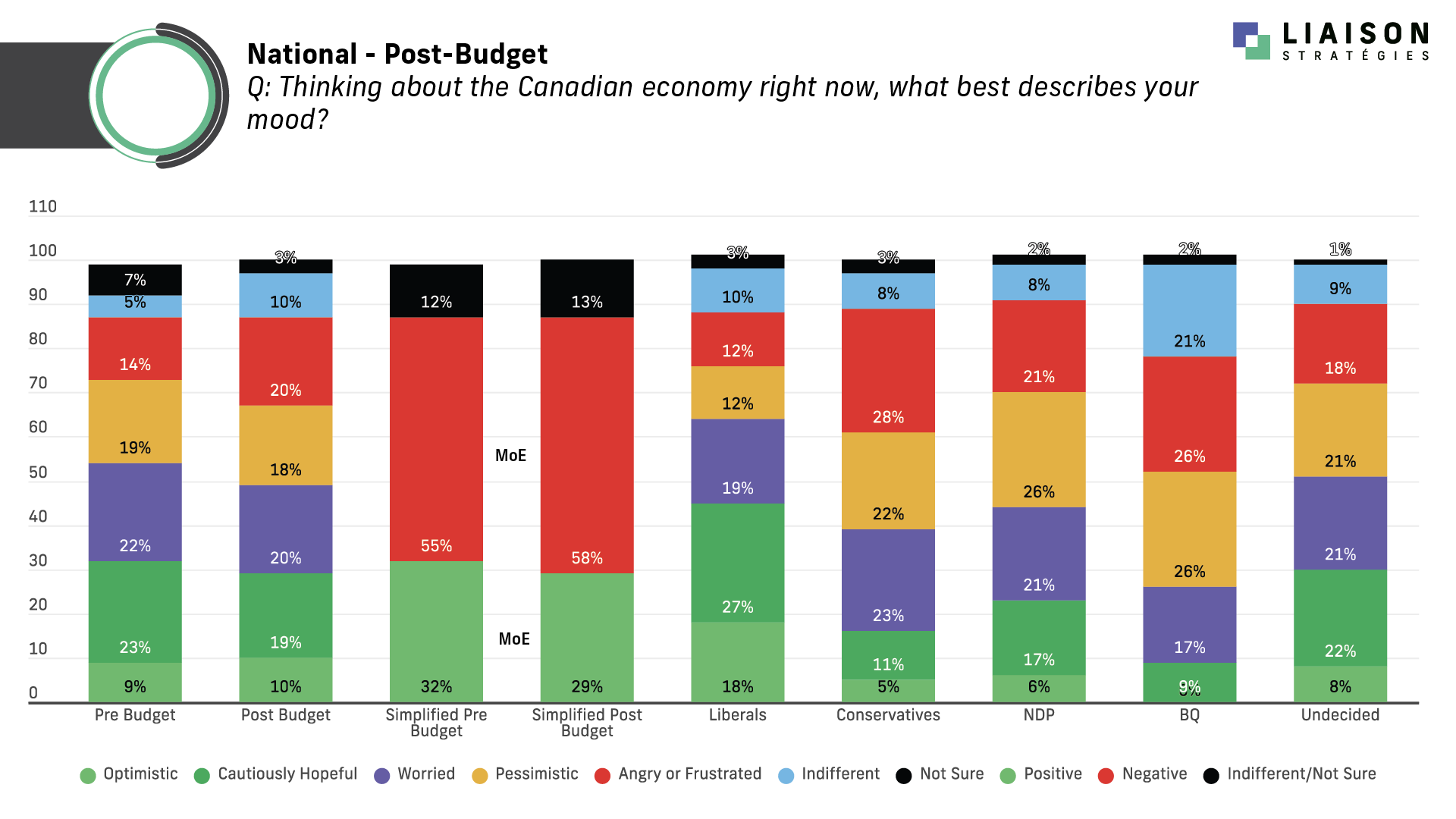
Turning to overall economic mood, this is where the limits of the budget become clearer. Canadians may feel better about the deficit and more aligned with current spending levels, but their outlook on the economy itself hasn’t shifted. The only movement outside the margin of error is an increase in those who say they feel “angry or frustrated,” up six points. In aggregate, though, the balance of positive and negative impressions remains within the margin of error when we compare pre- and post-budget results.
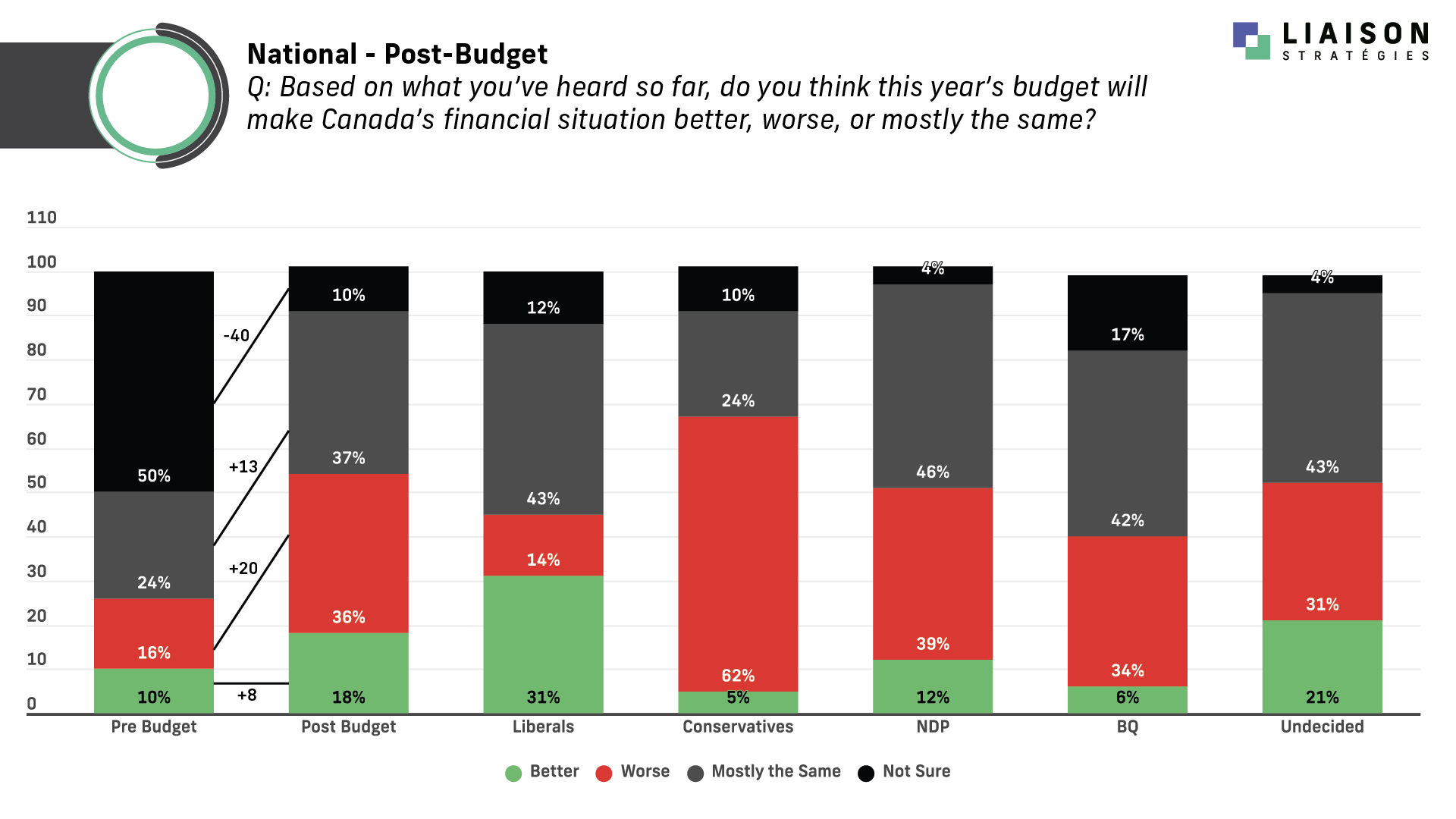
We see further limits when Canadians consider the budget’s impact on the country’s fiscal situation. Only 18 percent say it will make things better. Thirty-six percent believe it will make things worse, and another 37 percent say it will leave things mostly the same.
If you’re inclined to be an optimist, 55 percent say the budget will keep things steady or improve the situation. If you’re leaning pessimistic, 73 percent say it will keep things the same or make them worse.
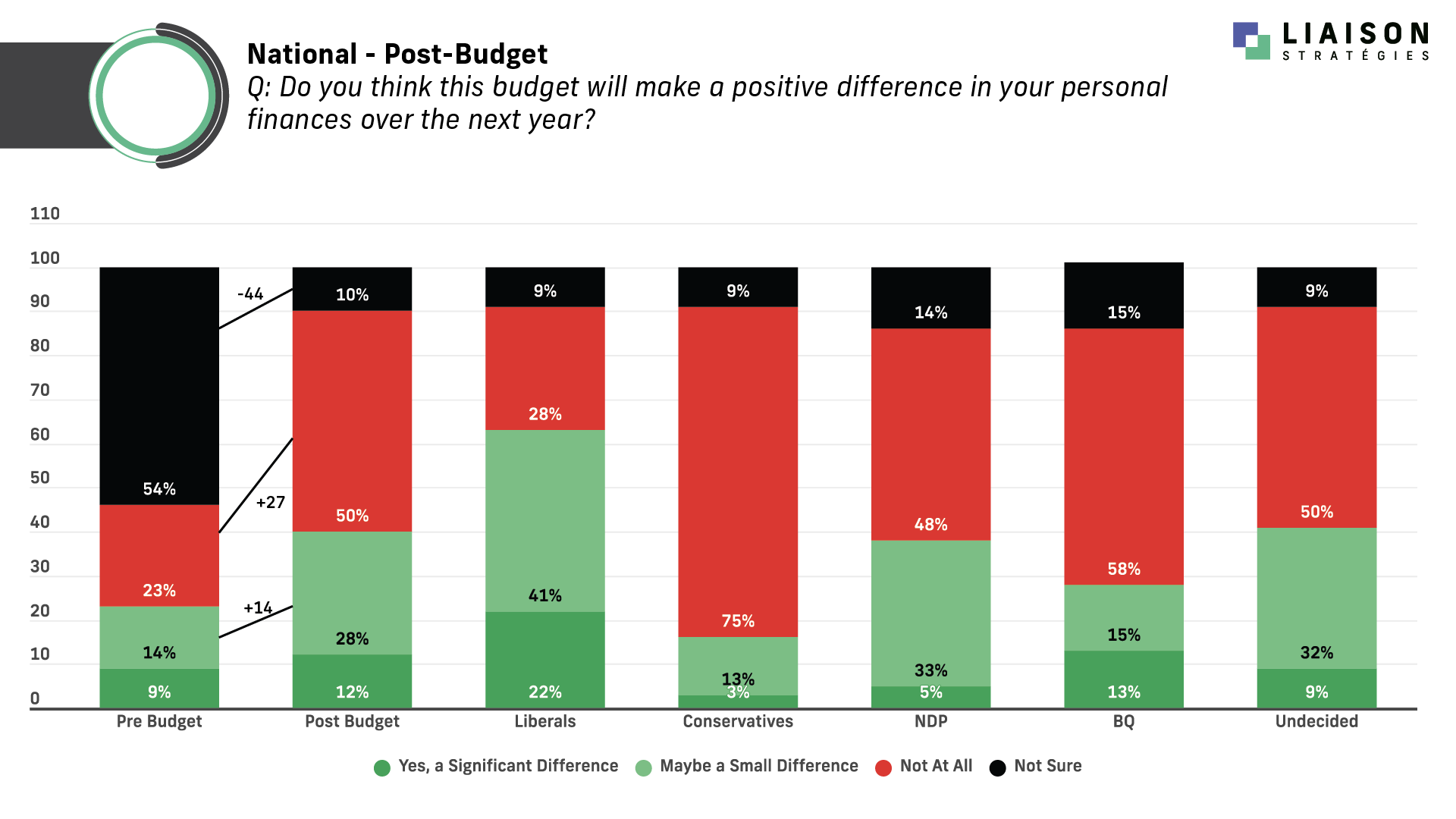
Most Canadians, 50 percent, also tell us they don’t expect the budget to make a positive difference for their personal finances over the next year. The share expecting a small improvement rises by 14 points, but the number saying it will make no difference at all jumps by 27 points after the budget.
Lastly, we asked Canadians about the opposition.
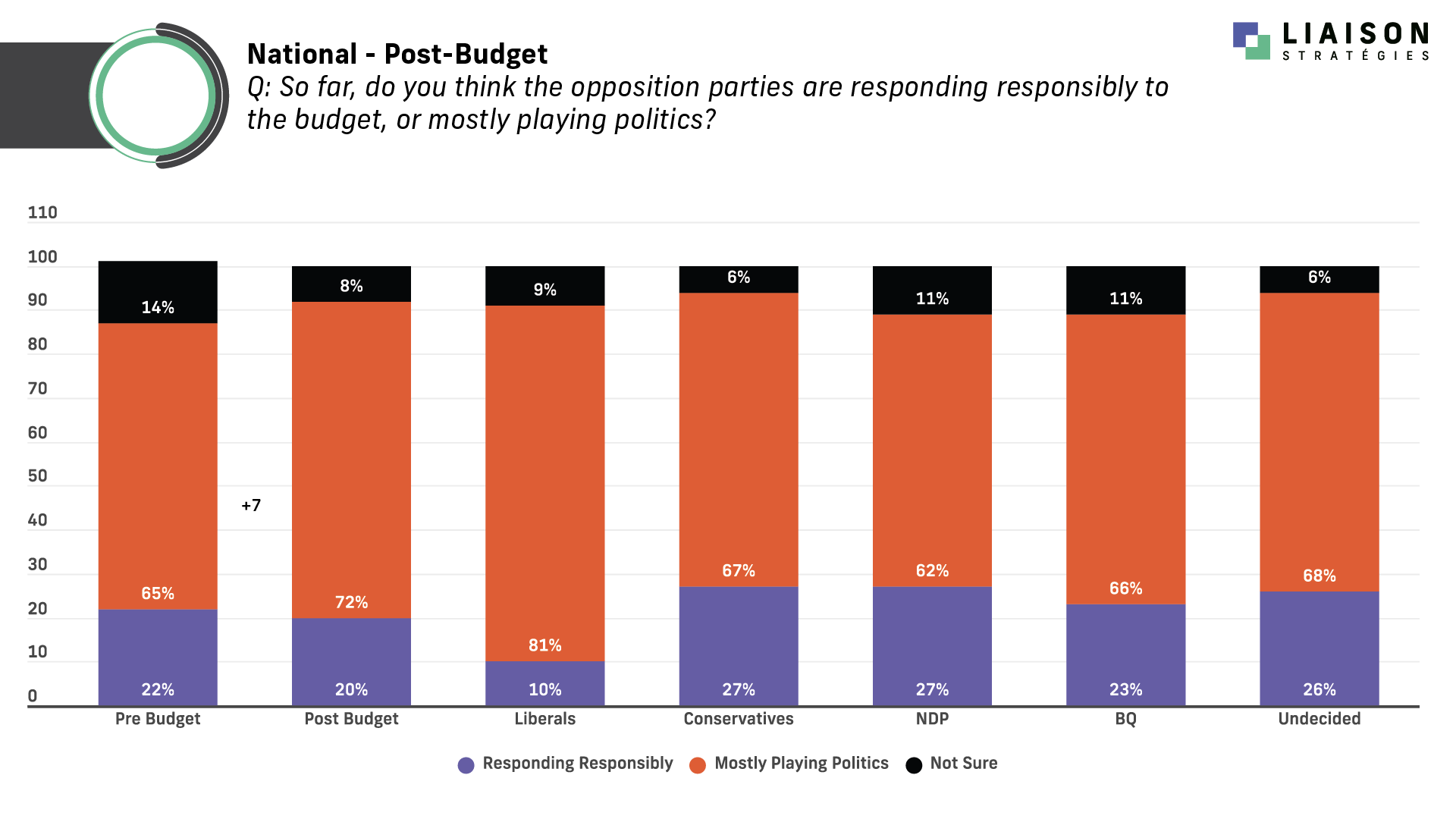
More Canadians now say the opposition is playing politics rather than acting responsibly, up seven points from before the budget. Some of this is almost certainly tied to election speculation, and the past week’s focus on internal Conservative politics likely contributed as well. Even among Conservative voters, 67 percent say the opposition parties are playing politics.
À propos de Stratégies Liaison
provincial et fédéral et est apparu dans les médias canadiens pour discuter de ses observations.
Liaison est membre du Conseil de recherche et d’intelligence marketing canadien, le porte-parole canadien des professionnels de la recherche, de l’analyse et de l’information, tant au Canada qu’à l’étranger.
